3.2 Sustainability performance
As we pursue our mission of building a sustainable tomorrow, we are committed to maximising our positive impacts on society and the environment and minimising our negative ones. And not just in the work we do, but in how we do it as well. In this chapter, we present BAM’s progress against strategic social and environmental targets and share selected key initiatives. Further disclosures are provided in chapter 6.3 and chapter 6.4.
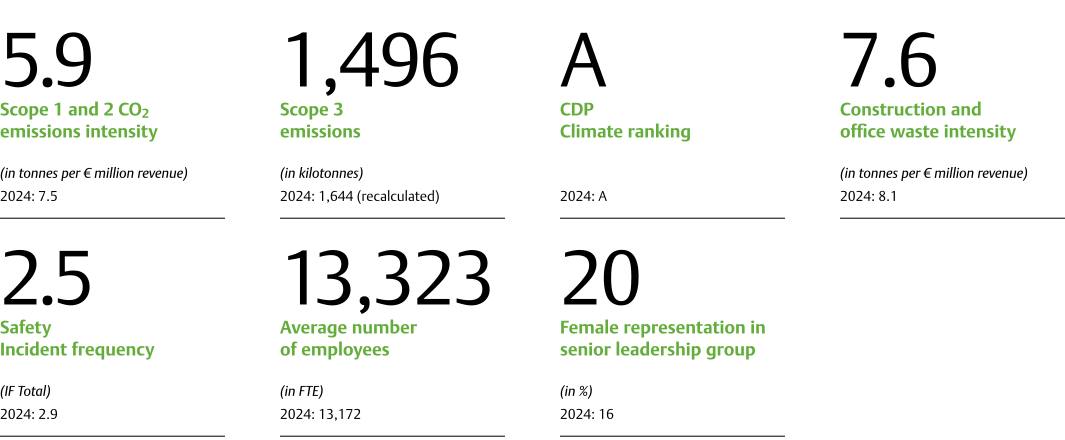
In 2025, BAM made good progress towards achieving its Sustainability targets: BAM continued to focus on improving safety and this was accompanied by a reduction in incident frequency. Carbon emissions have decreased, both in our own operations and in our value chain, and BAM was awarded a CDP Climate A score for the seventh consecutive year. We also managed to increase representation of women in senior leadership roles, although we are not yet meeting our targets.
Everyone Safe & Well Every Day
True safety is not just about rules – it is about culture. Our BAM Values – Sustainable, Inclusive, Reliable, Ownership, and Collaborative – guide our approach to staying safe and well every day. The founding principle is that safety and wellbeing are not just a priority within BAM; they are a fundamental part of who we are and how we work together. And this dedication to safety extends beyond the physical to include fostering a workplace in which people feel free comfortable to speak up and feel empowered to act. Every colleague should return home safe and well every day.
Everyone at BAM has a responsibility to follow our safety procedures, help others do the same, and to hold each other accountable based on our belief that no one should be injured by their work and that every accident or incident is one too many.
In 2024, we assessed our safety performance through interviews, workshops, system reviews, and field observations across BAM. This assessment identified high-risk activities and their underlying root causes. We then developed a plan to strengthen BAM’s safety culture and performance.
In 2025, BAM embarked on establishing a common and consistent safety language across the company, with a Group-wide safety programme (see the Standards & Systems paragraph, below, for more information). This programme is known collectively as Everyone Safe and Well Every Day.
Four workstreams have been tasked with developing and strengthening specific aspects of the safety programme. Below is an overview of these workstreams and their role in improving BAM’s safety and wellbeing culture and performance.
Standards & Systems
The Standards & Systems workstream was tasked with developing what have become BAM’s six Life Saving Rules and eight Safety Principles and Group Safety Standards. These address BAM’s highest-risk activities and are designed to prevent serious accidents or incidents in the workplace. The rules are specific and non-negotiable and cover both office and on-site locations. The workstream also supported the development in 2025 of aligned ways of working, safety reporting, management, and investigation systems across the company, and developed a mandatory all-staff e-learning course and ‘toolbox talks’ for our on-site operatives.
Conscious Leadership & Culture
Safety and wellbeing begin at the top of the organisation, and it is important that leaders not only set appropriate policies but demonstrate them too. We strengthened our leadership development in 2025 by launching the Conscious Leadership Journey for BAM's key senior leaders (consisting of the Executive Committee, Group Function Directors and Divisional Leadership Teams). This will be expanded to our senior leader cohort in 2026. The journey focuses on enhancing leadership skills and is aligned to the leadership competences in BAM's Leadership Framework. It aimed to strengthen our leaders’ impact and role modelling regarding safety and wellbeing.
As part of the leadership journey, two leadership summits were held purely about safety, and three real-life examples were explored using a practical, incident-based methodology designed to identify behavioural root causes, develop actionable solutions, and build ownership through stakeholder involvement.
Leaders were also tasked with undertaking Safety Visits on projects, supported by safety experts, to observe high-risk activities and understand the challenges faced by our teams on site.
Governance
Regarding safety governance, BAM’s goal is to maintain consistency across the organisation in terms of policies and approach, while respecting the differences in culture and legislation between the Netherlands, the United Kingdom, Ireland, and Belgium. In 2025, the programme reviewed and strengthened the division’s organisational design and capabilities, resulting in a fit-for purpose Safety and Wellbeing organisation. Internal reporting and decision-making forums were also reviewed, including the development of Group dashboards to support consistent, KPI-led safety discussions. A Group Director of Safety & Wellbeing was appointed in 2025 to continue to drive alignment.
Communications
In every organisation, communication – consistent and unmissable – is central to embedding a safety culture. So too is senior management leadership. Therefore, in 2025, the Communications workstream organised two BAM-wide town hall meetings on Safety. At the first, in April, BAM’s Executive Committee members talked about the importance of the six Life Saving Rules; in November, they shared real BAM safety stories from colleagues, including one about suicide-awareness and another about the life-changing impact of a serious workplace accident. As part of the ongoing communication around safety and wellbeing, the team developed a series of animated films to support bi-monthly spotlights on the Life Saving Rules.
Divisional safety and wellbeing steps in 2025
In 2025, Division Netherlands completed its rollout of the House of Vitality. Beginning with an extensive survey of work ability, work experience, productivity, and happiness, this ‘house’ gives employees insight into their own vitality. The results provide the division with information that can be used to direct improvements targeted at employees’ wellbeing, with the focus now moving from insight to action to address the themes identified. Supported by the Governance workstream, division Netherlands decided to align its multiple business segment health and safety IT systems in 2025, reducing them from eight to one. Implementation is to be finalised in 2026. This follows from a similar process the United Kingdom and Ireland division had already undertaken to rationalise systems.
Also in 2025, Division United Kingdom and Ireland made the first steps towards restructuring its organisation creating a Health, Safety and Wellbeing function, under a newly appointed director. This change aligns with the Group direction of connecting safety and wellbeing and create an organisational model that the Netherlands division will implement in 2026.
Embracing diversity, fostering inclusion
What if ‘building a sustainable tomorrow’ means more than delivering our projects? We believe true progress goes beyond physical structures, and our people are what set us apart to achieve our goals. In striving to build a sustainable tomorrow, it is important we make BAM a place for everyone. We strive to nurture an environment where everybody feels included, valued, respected, and empowered to share their ideas.
Representation of women in leadership roles
BAM is committed to meeting statutory requirements for gender representation in leadership roles. We go beyond compliance by creating an environment in which colleagues with different backgrounds, experiences, and identities are welcomed, respected, and empowered. We expect our leaders to value diverse perspectives.
To fulfil statutory requirements, BAM’s Supervisory Board must be composed of at least (33%) women and at least (33%) men. Since the Annual General Meeting in 2017, the composition of the Supervisory Board has been in line with this target. At the end of 2025, 50% of the SB members were women. Moreover, we aim for our Executive Committee (including the Executive Board) to consist of at least 25% women and at least 25% men. At the end of 2025, 40% of the Executive Committee members were women.
We have further set additional ambitions for the percentage of women in BAM’s senior leadership group (SLG) for the period to 2030. The SLG is defined as all employees in senior job grades (grades F, G, and H in BAM’s grading framework). Comprising approximately 140 employees in 2025, the SLG includes members of the Executive Committee and the directors of businesses and large business units. It also includes the most senior functional roles in the divisions and at the corporate centre. At the end of 2025, the share of women in the SLG was 20%, an increase from 16% at the end of 2024.
Female representation
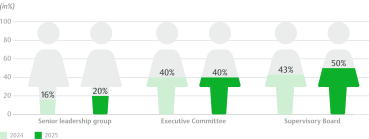
We are continuing to explore and leverage opportunities to retain and develop talent to meet our diversity targets. In 2025, these initiatives included:
-
We ensure an inclusive recruitment process to secure the best talent by equipping our recruiters with practical, inclusive recruitment techniques. Including embedding inclusive approaches in talent pooling, candidate search, and candidate assessment. As a result, we’ve seen a consistent upward trend in the number of women joining BAM.
-
Continuing to focus on fair, transparent and objective development, progression, and promotion. This has contributed to increasing the proportion of managers who are women in the Group by 5% since 2021, and a 2% increase in 2025. With more women in manager positions, we aim to increase the number of women in our succession planning and at senior levels.
-
Sponsoring AmplifyHER, a women’s visibility and leadership event in Amsterdam. BAM participated in the Mavericks panel, reaffirming the role of men in creating an inclusive workplace, and hosted a career workshop for 250 prospective future colleagues. The event raised BAM’s profile as an inclusive employer to 500 attendees and supported 30 male and female BAM colleagues develop their skills in inclusion.
Our Diversity and Inclusion approach is tailored to each country BAM operates within, ensuring compliance with local legislation and relevance to cultural needs, whilst aligning with the Group strategy.
A workplace where everyone is included
BAM is committed to nurturing a workplace where everyone feels included. This is essential for making the Group stronger, safer, and more innovative.
We measure inclusion through regular Return on Inclusion assessments, undertaken by an external partner. The assessment considers 20 different aspects of inclusion ranging from HR practices, operations on site and inclusion within our supply chain and customers. The goal is to ensure we weave inclusion throughout our operations, targeting a score of 71 (Gold) or higher by 2030. Based on the recommendations that emerged from the 2023 audit, we have embedded key actions to strengthen BAM’s position and drive progress towards our intermediate target of achieving a score of at least 60 (Silver) by 2026.
A 2025 health check across our divisions showed strong improvement in areas such as inclusive leadership and data-driven decision-making, and are preparing for the ROI audit planned in 2026.
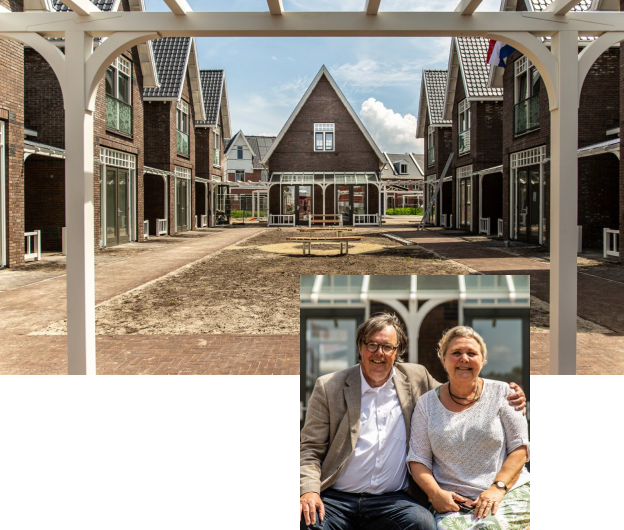
Some examples of how our inclusion networks created meaningful impact in 2025 are:
-
FutureBAM connected over 1,200 colleagues through site visits, strengthening understanding of our projects and fostering cross team collaboration.
-
Ability@BAM has influenced the design of new office spaces, ensuring accessibility is considered from the outset.
-
BAM Proud works closely with WorkPlace Pride to introduce practical actions that help LGBTQ+ colleagues and allies feel supported and respected.
These examples demonstrate how our networks help us build a culture of openness, empowerment and shared ownership — one that reflects the diverse communities we serve and strengthens our ability to create a sustainable tomorrow.
This year, our focus for inclusion was to strengthen the role of our nine inclusion networks to create an inclusive workplace. Overall, these networks upskilled more than 1,700 colleagues in 2025, helping us deepen awareness about inclusive behaviours, invite diverse perspectives into our organisation and supporting BAM to attract diverse talents to deliver on our sustainability strategy. Our networks work collaboratively across the Group, acting as a golden thread to embed inclusion in our culture and operations.
Looking ahead
2025 is the the penultimate year of our current strategic reporting period, and over 2026 we will review our progress made to date on our D&I targets and amend or adjust them accordingly.
Social value
BAM aims to generate social value as a way to make a lasting societal impact, see also the Value creation model. We do this by engaging with and reinvesting in the communities where we work, with the aim of enhancing people’s lives. Our initiatives include supporting local procurement and employment, providing apprenticeships, and volunteering in local community projects. To calculate how much we contribute, we apply commonly used social value models that attribute a monetary value to activities that enhance social and local economic value. While both divisions still have progress to make to reach the 2026 targets, we have robust improvement plans in place, focusing on better reporting and broader business engagement. For more information about this metric, see chapter 6.4.
BAM is a member of both the Considerate Constructors Scheme (CCS) in the United Kingdom and its Dutch counterpart, Bewuste Bouwers. Under these schemes, our construction sites adhere to a code of conduct that encompasses principles for respecting the community, protecting the environment and valuing the workforce. For further details, see chapter 6.4.
Reviving Lynemouth’s Coastline and Community
The Lynemouth Beach Remediation Scheme restored a coastline scarred by decades of industrial waste, removing over 95,000 tonnes of material to protect marine habitats and create a cleaner, safer environment for residents and visitors. Beyond environmental recovery, the project delivered 48% social and local economic value, strengthening the local economy and community resilience through education, skills development, and inclusive employment opportunities. Partnerships with schools and colleges inspired future talent, while volunteering and mental health initiatives fostered wellbeing and social inclusion. With 72% of project spend directed to local vendors and £2 million in social value delivered, the scheme demonstrates how sustainability can transform places and lives.
Division United Kingdom and Ireland
Our strategic target for division United Kingdom and Ireland is to deliver 35% social value by 2026. In 2024, the division introduced a Social Sustainability Reporting Tool to track performance in social inclusion, foundational economy, and social mobility. In 2025, the division generated €681 million social value across these three themes, representing 19.9% of revenue (2024: €487 million, 15.6% revenue). This increase reflects the more structured approach taken by the division to delivering social value at each stage of construction. It rolled out segment-focused action plans, a pilot programme to fund work trials for marginalised groups, and workshops to improve social procurement (e.g. spend at voluntary, community, and social enterprise (VCSE)) at BAM and in our supply chain.
Division Netherlands
In division Netherlands, public sector projects often include obligations to deliver social return on investment (SROI), a method of delivering and measuring social value in projects. The focus is on people who face barriers to entering the labour market and who can be supported directly through placements and employment, or indirectly through social procurement, e.g. spending with social enterprises or sheltered workshops. Other activities can also contribute to social return on investment, such as school visits to engage primary- and high-school students.
Division Netherlands has committed to delivering 5% social value on top of these SROI obligations by 2026. In 2025, the majority of projects in scope were assessed, delivering a total of €13.9 million SROI. This results in 12% additional social value. Over the year, the division focused on developing a new Social Value Reporting manual and policy, on raising awareness and knowledge about social value within the organisation, and on streamlining processes to enhance early engagement on this topic at project level.