6.1 Approach to sustainability reporting
In this section we disclose BAM’s sustainability statement in accordance with European Sustainability Reporting Standards (ESRS), as adopted by the European Union. Central to the approach is the Double Materiality Assessment, which identifies material impacts, risks and opportunities connected with BAM’s own operations and direct and indirect business relationships in the upstream and/or downstream value chain.
BAM considers sustainability to be a prime driver for the company's future business and its ability to create long-term value. BAM aims to be a leader in the industry to create a socially and environmentally sustainable environment. Progress is measured continuously, through which BAM is encouraged to deliver sustainable solutions and actively engage with stakeholders to accelerate the sustainability goals.
BAM consistently fosters communication and dialogue with both internal and external stakeholders to learn about the perspectives and concerns of those parties impacted by the company's activities and how they in turn can impact BAM. Such interactions not only expand BAM’s knowledge base, but also enhance its capacity for sound decision-making and the effective prioritisation of actions.
BAM determined which sustainability-related impacts, risks and opportunities were material to stakeholders and the company. The topics identified through the double materiality assessment are used for strategic direction and control on material sustainability matters. The response to material sustainability impacts, risks and opportunities is fully integrated into BAM’s organisational processes. The material impacts, risks and opportunities are subsequently used to determine the scope of BAM’s sustainability reporting. The implementation of the double materiality approach and related sustainability reporting is not intended as a compliance exercise but to drive strategic embedding of sustainability in BAM’s activities, aiming to achieve sustainable change and a resilient company.
BAM's value chain
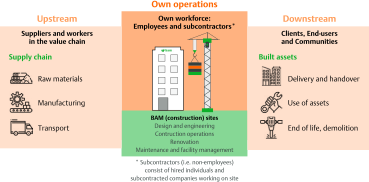
Sustainability is a key driver in BAM’s business model and strategic decision making. In executing the strategy and driving the sustainability targets, the company continues to support and encourage clients and the supply chain to accelerate their sustainability goals. BAM works with value chain partners and other stakeholders to fully leverage its contribution to the planet and people themes.
BAM's value chain spans activities that turn client needs into built assets while minimising environmental and social impacts. Upstream, business development, design and procurement drive value through planning and the selection of sustainable materials, equipment and partners. Core construction activities - including site preparation, engineering, project management and quality controls - deliver value by practising safety, resource efficiency, waste reduction and technical performance. Downstream functions such as commissioning, handover and maintenance services reinforce long-term performance and contribute to the lifecycle sustainability of the asset.
Double Materiality Assessment
In 2025, the company updated its Double Materiality Assessment (DMA) in line with the European Sustainability Reporting Standards (ESRS), building on the comprehensive assessment conducted in 2023 and the update in 2024 as the foundation for this review. ESRS 2 defines the frequency of sustainability reporting under the ESRS as annual, given that the sustainability statement is part of the BAM’s management report. Accordingly, BAM’s continuous risk processes are aimed at monitoring and updating its material impacts, risks and opportunities, and material information to be included in the sustainability statement. The process followed four key phases: identification, assessment, processing of results, and validation. This structured approach ensured that material sustainability impacts, risks and opportunities were reviewed comprehensively and updated where necessary.
Following this process, BAM concluded the updated list of material impacts, risks and opportunities as of the reporting date. Compared to the previous reporting year, the following changes have been made: the positive impact of ecosystem services, the opportunity related to energy efficiency, and the climate‑risk impact on the land bank are no longer considered material. In contrast, the Dutch nitrogen crisis has been classified as material risk impact, and the energy transition has been classified as a material opportunity.
The Executive Committee and Supervisory Board validated the approach and outcomes, supported by their respective committees.
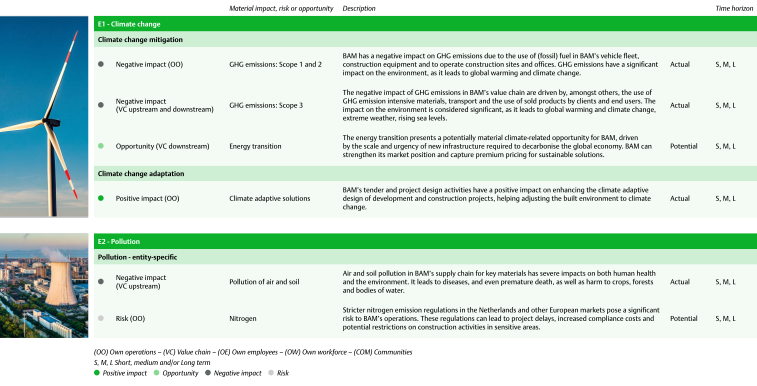
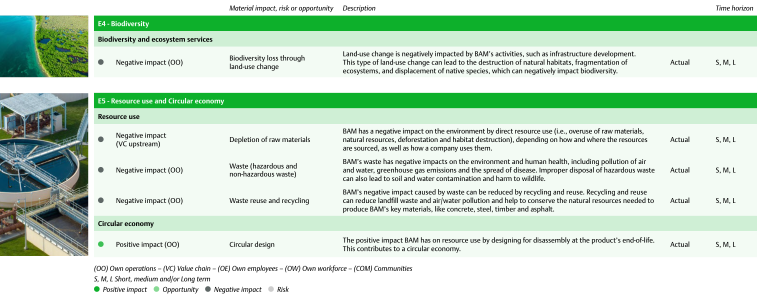
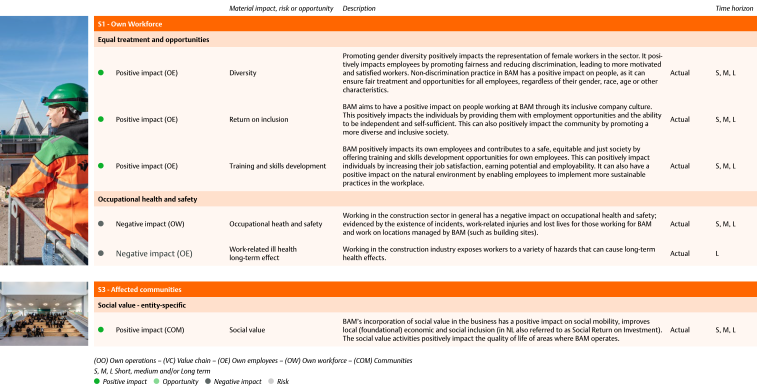
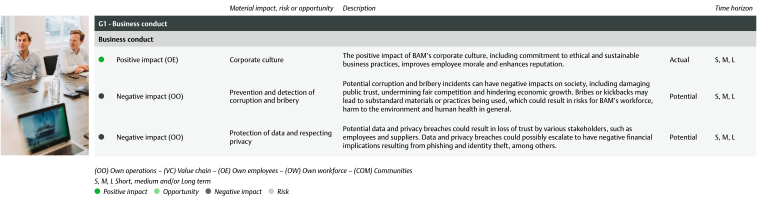
The tables in this paragraph show BAM’s material sustainability impacts, risks and opportunities. The methodology and underlying assumptions of the double materiality assessment are included in the grey box on the next page.
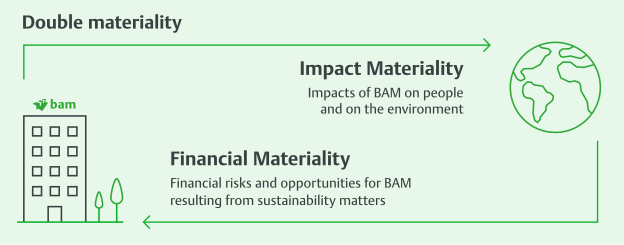
Double materiality has two dimensions: impact materiality and financial materiality. Thus, the methodology used for this assessment is based on two processes. The first process involves the identification, assessment and prioritisation of actual and potential impact made by BAM on people and the environment. The second process focuses on the identification, assessment and prioritisation of financial risks and opportunities for BAM associated with Environment, Social and Governance (ESG) topics. Following the methodology of double materiality assessment, BAM actively solicited input and feedback from internal and external stakeholders to gain a comprehensive understanding of the most pressing concerns to stakeholders. This approach helps to establish evidence of actual or potential impact on both people and the environment associated with the company's activities, particularly from the perspective of stakeholders who may be directly impacted.
Reporting principles and assumptions
Scope
The double materiality assessment encompasses all the activities of BAM. This extends to BAM’s upstream activities, own operations and downstream activities, covering all associated geographical regions.
Impact Materiality
A sustainability impact, risk or opportunity is material from an impact perspective when it pertains to BAM’s actual or potential, positive or negative material impact on people or the environment over short-, medium- and long-term time horizons.
BAM determined a quantitative threshold, which was also made qualitative to support internal dialogue sessions. The materiality of an impact is based on the scale and scope of the impact, the irremediable character (in case of negative impacts) and the likelihood of impact to occur. An impact is material if it is scored ‘critical’ or ‘high’. The impact is not material if it is scored ‘medium’, ‘low’ or ‘negligible’.
Financial Materiality
A sustainability-related risk or opportunity is material from a financial perspective if it triggers or may trigger material financial risks or opportunities for BAM. This is the case when it generates or may generate risks or opportunities that have a material effect (or are likely to have a material effect) on BAM’s cash flows, performance, position, cost of capital or access to finance in short-, medium- and long-term time horizons.
The materiality of a financial risk or opportunity is based on the magnitude of the effect and likelihood of the risk or opportunity to occur. BAM determined a quantitative threshold, which was also made qualitative to support internal dialogue sessions. A financial risk or opportunity is material if it is scored ‘critical’ or ‘high’. The financial risk or opportunity is not material it is scored ‘medium’, ‘low’ or ‘negligible’.
Thresholds positive and negative impact materiality
BAM has set a lower threshold for negative sustainability impacts. The company aims to protect itself from risks, align with stakeholder expectations and ensure long-term success. While positive impacts are valuable, the costs and consequences of negative sustainability outcomes can be far more severe and harder to reverse, warranting stricter thresholds.
Gross (inherent) or residual risks and opportunities
BAM identifies material impacts excluding the consideration of any mitigating measures. Compliant with ESRS, BAM discloses gross impacts and the (potential) actions taken to mitigate the negative impacts. BAM identifies gross material financial risks and opportunities. In specific circumstances, BAM considers mitigating activities in determining the financial effects for the company. Risk mitigating activities could change the expectation of the effect of the risk on the company, or change the extent to which the company's financial position is affected. Therefore, risk mitigation activities could affect the expectation of whether and how a sustainability-related risk might affect BAM’s financial position. A description of the mitigating measures considered in BAM’s risk assessment is below:
-
Clients will be paying a premium for certain services or covering higher costs levels in the industry, for example due to carbon pricing consequences in BAM’s supply chain.
-
As is common industry practice, BAM insures its construction projects against material damage caused by extreme weather.
Interactions with stakeholders
In 2025, the double materiality assessment update has been reviewed by the Risk and Control committee, Executive Committee and Supervisory Committees (Audit committee and Health, Safety and Sustainability committee).
Identification of topics
BAM conducted a review to identify a broad range of potential topics relevant to the company. The review included a media analysis related to the industry, review of internal documents, review of the previous materiality assessments, peer benchmarking, and a global standards review, including the list of potential sustainability topics in ESRS 1. In this process BAM focused on for example specific activities, geographies that possibly gave rise to heightened risks or adverse impacts. BAM also explicitly identified impacts through its own operations or as a result of business relationships.
To refine the list of potential topics, BAM engaged in dialogue sessions with internal stakeholders across its divisions.
Initially, in 2023, participants were invited based on their expertise in Environment, Social, Governance, and Finance to discuss actual and potential impacts, risks and opportunities. In 2025, the company updated the list and invited a total of 85 participants, representing a diverse group from all our divisions: Group, Netherlands, and UK and Ireland. The participant group included individuals with different areas of expertise and a variety of roles and levels within the organisation, ensuring a broad and inclusive perspective.
Assessment of impact materiality
During the dialogue sessions in 2025, internal stakeholders were invited to evaluate a set of materiality-related impacts. Twelve priority impacts had been identified in advance to guide the discussion. These impacts were identified based on the scoring from the 2023 assessment and the following criteria:
-
Positioned close to the threshold for materiality; and/or
-
Frequently misinterpreted by stakeholders regarding whether the impact is positive or negative; and/or
-
Classified as ‘phased-in’ during the 2024 DMA.
Participants evaluated each impact, risk or opportunity against the following criteria: scale, scope, irremediable character (for negative impact) and likelihood (for potential impact).
Impacts, risks and opportunities were classified as material when results exceeded predefined thresholds, aligned with BAM’s Enterprise Risk Management (ERM) process. To ensure informed participation, BAM provided pre-read materials, Q&A sessions and one-on-one meetings.
The phased-in impacts:
-
Training and skills development
-
Work-related ill health
The impacts phased in under the DMA last year were revisited during our dialogue sessions to challenge and validate their relevance under current conditions. The assessment confirmed that both phased-in impacts remain material from an impact perspective. Accordingly, this reporting year, these impacts will be disclosed in alignment with our materiality analysis and applicable sustainability reporting standards.
Assessment of financial materiality
BAM sought to align the assessment of financial materiality as closely as possible with its existing risk management processes. Risk management and finance experts participated in dedicated dialogue sessions to identify and evaluate potential financial risks and opportunities.
During this process, BAM considered how its impacts and dependencies could give rise to related financial risks and opportunities. The assessment began with the identification of themes while maintaining links to prior analyses, including the phased-in financial effects on land banks and energy efficient buildings. This approach resulted in the identification of topics connected to the balance sheet (assets) and the income statement (both costs and revenues). We conducted a series of investigations into financial risks and opportunities, including land bank valuation under climate risk, tax implications of sustainability measures, and the transition from grey to green revenue streams.
Each risk or opportunity was assessed using a combination of quantitative analysis and qualitative insights, ensuring that decisions were grounded in data while incorporating expert judgment where necessary.
-
Financial risk of climate change on BAM’s land bank valuation:
Potential impacts from flooding and land subsidence were quantified, but even under worst-case scenarios, the financial effect remained below the threshold. -
Tax related to sustainability costs:
Tax credits and obligations linked to sustainability were evaluated, resulting in a limited financial effect, well below the materiality threshold. -
Transition to green revenue:
While the strategic importance is high, the financial risk associated with non-green revenue was assessed as limited and not material given BAM’s project-based portfolio and ongoing alignment with EU Taxonomy. -
World trade tariffs:
An extra check was performed on global tariff disruptions and their potential impact on construction materials such as steel, aluminium and timber. The financial effect of tariff-related risks is estimated, the expected loss remains below BAM’s materiality threshold and is therefore considered not material.
The process commenced with structured dialogue sessions involving internal subject-matter experts to assess whether these risks and opportunities should be considered material.
Stakeholder dialogue sessions further explored these risks and opportunities, and participants were invited to propose additional items for consideration. For risks and opportunities assessed as material, BAM conducted in-depth analyses to quantify, where possible, the magnitude and likelihood of each identified financial risk or opportunity.
Subsequently, additional internal analyses were performed, integrating both quantitative and qualitative approaches to evaluate the potential financial materiality of these risks and opportunities. The outcomes of these assessments were validated through further engagement with relevant experts and BAM’s risk and finance leadership.
Following the financial materiality assessment, BAM performed a stand-back analysis to review the outcomes in the context of benchmarking, additional evidence and overall consistency with our strategic narrative and Enterprise Risk Management (ERM) framework. The purpose of this analysis was to determine whether any impacts, risks and opportunities required inclusion beyond the stakeholder assessment results to present a comprehensive picture of BAM’s material issues.
As a result, we concluded that the financial risk related to the nitrogen crisis in the Netherlands and the opportunity in the energy transition market should be classified as financially material for BAM. This decision reflects our commitment to completeness and transparency rather than overriding stakeholder input.
-
Nitrogen remains a significant risk in the Netherlands, influencing our ability to execute projects and secure future revenue. Legal and regulatory developments can pose (additional) risks for potential cancellations or delay of projects.
-
Energy transition represents a key opportunity aligned with BAM’s strategic priorities and long-term value creation, driven by the scale and urgency of new infrastructure required to decarbonise the global economy.
These risks and opportunities have no associated assets and no direct link to the financial statements, other than their potential impact on future revenue generation. From BAM’s perspective, this is not a contingency matter but a forward-looking consideration essential to our strategy.
Validation of results
For each impact, risk and opportunity, we assigned a score, based on the applicable calculation methodology, as to whether it related to impact materiality or financial materiality. Using predefined quantitative thresholds, we could immediately see whether an impact, risk or opportunity met the criteria to be considered material.
During the dialogue sessions, we included a validation step within the group discussion and, where necessary, conducted additional one-on-one reviews with subject-matter experts to ensure accuracy and completeness.
During one of the dialogue sessions, experts highlighted water as a topic that warrants further investigation. The discussion focused on whether water should be considered material for our organisation at this stage, or whether it requires deeper analysis in future dialogues. Based on our current assessment, water is not considered a material impact, risk or opportunity for our operations. However, given the feedback received and the growing importance of water-related issues in sustainability frameworks, we will continue to monitor developments and reassess its relevance in upcoming materiality reviews.
For financial materiality, we combined qualitative insights with quantitative analysis. This approach strengthened the identification and classification process by grounding decisions in data while incorporating expert judgment where needed.
The integrated approach strengthened the identification and classification process by combining data-driven analysis with expert judgment. A validation step through stand-back analysis confirmed the classification of two material topics.
External stakeholders
Throughout 2025, BAM continued to engage with external stakeholders through numerous discussions centred around various ESG topics, as summarised in the table below.
These qualitative insights and context-specific perspectives helped shape the views of internal stakeholders on the identification and assessing of material impacts, risks and opportunities. During the validation process, stakeholder feedback also played a key role in confirming the relevance of the identified topics.
External stakeholder overview
|
External stakeholder |
Processes and communication |
Matters discussed |
|
Clients |
Joint project and business development, strategic partnership, workshop, (social) media, in-person meeting, podcast recording |
Collaboration on sustainability, circularity |
|
Knowledge institutions |
In-person meeting, workshop, online meeting |
Circularity, water scarcity, decarbonisation |
|
Local communities |
In-person meeting, workshop, information market, guest lecture, open office hours, BouwApp, voluntary work community |
Safety during construction works, noise pollution and other disturbances due to construction works |
|
Suppliers and subcontractors |
In-person meeting, online meeting, virtual event |
Timber certification, circularity, sustainability strategy, supply chain, hydro-treated vegetable oil (HVO), petrol engine alternative products, hydrogen and innovation |
|
Industry bodies |
Virtual event, conference, workshop, round-the-table event, in-person meeting, online meeting |
Decarbonisation, sustainability nature-based solutions, climate adaptation, biodiversity, nature positive initiatives, sustainability strategy, innovation, social value |
|
Regulators |
In-person meeting, online meeting |
Sustainable mobility, regeneration, climate resilience, HVO adoption by the industry, combatting climate change, sustainability strategy, carbon reduction, biodiversity |
|
Investors and analysts |
In-person meeting, online meeting, round-the-table event |
Biodiversity, working conditions in the value chain, natural capital, human rights, biodiversity, sustainability |
|
NGOs and trade unions |
In-person meeting, online meeting, (social) media |
Decarbonisation, safety |
|
Media |
Conference, media content |
Decarbonisation, energy transition |
Material sustainability impacts, risks and opportunities in 2025
The following tables list the sustainability-related impacts, risks and opportunities BAM has identified and assessed as material as a result of the double materiality assessment process. Each material ESRS topic is presented in the following tables, including sub-(sub)topics related to BAM’s material impacts and risks, e.g. climate change mitigation and climate change adaptation.
In addition, BAM indicates in the tables whether the impacts, risks and opportunities lie in the company's own operations (OO) or value chain (VC). For the social material impacts, BAM indicates whether it affects its own employees (OE), own workforce (OW) or communities (COM).
Impacts are actual impacts, risks or opportunities unless stated that they are potential impacts. Brief descriptions of the material impacts, risks or opportunities are included in the tables. More information on how BAM responds to the effects of the impacts, risks and opportunities is included in the topical sections under ‘Environment’, ‘Social’ and ‘Governance’.
BAM recognises that the on-going due diligence and double materiality assessment process will be refined over time. The company further specifically notes that the sustainability statement may not include every impact, risk and opportunity or additional entity-specific disclosure that each individual stakeholder (group) may consider important in its own particular assessment. BAM also expects more robust outcomes through increased data insights and more clarity on the practical implementation of the guidelines and comparability across the industry in the coming years.
Disclosure requirements
The outcomes of the double materiality assessment are fully integrated in BAM’s risk management process. BAM derives forward looking guidance from this outcome and includes the relevant insights in strategy iteration and priority setting in business programmes, targets and reporting.
The relevant disclosures on material sustainability impacts, risks and opportunities are included in this report provided that the data and information are available and meet the necessary quality standards. The sustainability statement not only highlights BAM’s commitment to transparency and to informing stakeholders about sustainability performance, but it also serves as a cornerstone for nurturing a responsible and resilient business approach. BAM is committed to transparency both in its knowledge and in areas where information may be lacking, striving to maintain openness in the company's reporting.
All the disclosure requirements that have been complied with following the outcome of this double materiality assessment are included in chapter 6.7.