6.2 General information and sustainability reporting principles
BAM’s aim to continuously improve reporting transparency on sustainability performance and progress with respect to the strategy, resulted in this sustainability statement as part of the management information provided in this report.
Basis of preparation
Reporting framework and specific regulation (BP-1)
The sustainability statement disclosed in this annual report has been prepared on a consolidated basis in accordance with the European Sustainability Reporting Standards (ESRS) as adopted by the European Commission and compliant with the double materiality assessment process carried out to identify the information reported pursuant to the ESRS. The sustainability statement also complies with Article 8 of Regulation (EU) 2020/852 (Taxonomy Regulation), referred to in chapter 6.6 specifically.
The scope of the consolidation in the sustainability statement is the same as for the financial statements, including BAM’s subsidiaries. The subsidiaries are exempted from individual or consolidated reporting pursuant to Articles 19a(9) or 29a(8) of Directive 2013/34/EU. In addition, BAM applies the ESRS to define the organisational boundary for reporting sustainability information.
-
Own operations refers to the full range of activities and processes directly controlled by BAM. This includes all operational aspects where the company has direct managerial control and decision-making authority. BAM defines own operations as parent plus subsidiaries. Acquisitions and divestments are disclosed in line with their inclusion in the financial statements.
-
BAM additionally assesses the level of operational control for its joint arrangements. Operational control (over an entity, site, operation or asset) is defined as the situation where BAM has the ability to direct the operational activities and relationships of the entity, site, operation or asset. The reported GHG emissions should reflect the terms and conditions of the relevant agreements. In construction projects, control is typically reflected in the share of the involved parties according to their agreed-upon contributions and risk-sharing arrangements. Despite joint decision-making protocols in most of these arrangements, operational contribution is prearranged and assigned explicitly to the different parties (i.e., expertise), reflecting in, for example, appointing key personnel and controlling day-to-day operations on specific phases of the project. Based on this practice, BAM’s operational control is assumed to be equal to the equity share of BAM in the joint operation.
-
Quantities of materials used in the production of BAM’s products and services relate to own operations but are based on materials procured in the company's value chain. This sustainability information focuses on BAM’s own operations and does not directly measure the impact of the entire value chain. However the impacts that arise from the upstream value chain are indirectly linked our own operation.
-
The topic-specific definitions, methodology, reporting principles and assumptions are explained in the notes to the topical disclosures.
Further information on BAM’s value chain is included in chapter 6.1 Approach to sustainability reporting.
Comparative figures have been disclosed in line with current year reporting principles and assumptions, and any topic specific deviations are disclosed.
BAM anticipates that comparatives will become progressively available after the first year of reporting. This will make the sustainability information presented in the sustainability statement more useful.
Disclosures in relation to specific circumstances (BP-2)
Time horizons
In general, BAM assesses material impacts, risks and opportunities over the short, medium and long term. The short term refers to the reporting period of the financial statements. Since sustainability-related matters often materialise over time, the nature of these topics warrants more forward-looking reporting. In line with the strategic period (2024-2026) BAM defines:
-
2026 as short term;
-
between 2027 and 2030 as medium term; and
-
beyond 2030 as long term.
In the construction sector, project lifecycles can vary significantly. In general, medium-term planning focuses on projects or goals within the span of current pipelines and contracted projects. However, in the initial effort to implement the double materiality process, BAM has opted to define a narrower timeline. This approach is intended to focus on short-term initiatives that can drive immediate improvements in sustainability performance.
BAM also recognises that external pressures (e.g., customer expectations, regulations) prioritise a shorter time horizon for achieving certain medium-term sustainability objectives. BAM aims to refine these terms going forward to demonstrate further alignment between sustainability planning, business strategy and sector realities.
Estimations, sources of estimation, and outcome uncertainty
Making judgements, assumptions and estimates is a fundamental part of preparing sustainability related disclosures. Useful contextual assumptions and those that can significantly impact measurements are explicitly disclosed in the sustainability statement to aid in the interpretation of sustainability information.
For specific metrics, BAM uses information from its value chain partners, i.e. Scope 1, 2 and 3 reporting, incident frequency (including hired workers, subcontractors), and waste (intensity). In these cases, the disclosed accounting principles clarify where, if applicable, BAM relies on third party input for its data. Reporting based on third party data deals with measurement uncertainty; for example, due to the quality or availability of data from value chain partners. BAM also used indirect sources such as industry-average emission factors, spend-based approach and extrapolations, predominantly in the calculation of GHG emissions (Scope 3) associated with BAM’s suppliers and customers and, also related to the Scope 3 GHG emission baseline for 2019 and the reporting of key materials (resource inflows). These metrics are subject to a high level of measurement uncertainty. See Scope 3 GHG emissions (E1-6) and Resource inflows (E5-4) for further details.
BAM acknowledges that data sources and estimates may be refined in future reporting periods when more relevant information becomes available. Also, information to assess industry benchmarks (for example, used for estimated data with regard to resource inflows) may emerge as the number of reporters increases and reporting practices become more established.
Notwithstanding any uncertainties highlighted, the sustainability statement is prepared and presented in accordance with the requirements of the ESRS and applicable legislation.
Forward looking information
By nature, forward looking information, like plans and targets, involves risk and uncertainty because it relates to future events and circumstances. There are many factors that could cause actual results and developments to never occur or to differ materially from those expressed or implied.
Changes in the preparation or presentation of sustainability information, and reporting errors in prior periods
Changes in previously reported information can result from adjustments or restatements in the sustainability information for one or more periods.
-
Restatements as a result of errors - these errors may arise from misuse or failure to use reliable information that was available and BAM reasonably could have obtained and considered. The continuous strengthening of internal control practices related to sustainability reporting aims to mitigate the risk of errors in reported information.
-
Adjustments of prior period information as a result of changes in estimates and changes in methodology - these adjustments arise when new information or new developments provide additional insight about prior period cirucumstances resulting in a change in an estimate.
BAM has a sustainability reporting restatement policy that describes the principles used in case of restatements and adjustments (including both errors and changes in estimates). BAM assesses on a case-by-case basis whether the restatement or adjustment is material for the sustainability statement, including both qualitative and quantitative factors. If considered material, the prior-period reported data will be restated or adjusted, unless it is impracticable to do so. The reason why information is revised is disclosed alongside the topical disclosures.
In 2025, BAM updated the GHG Scope 3 emission factors used in spend-based calculations to the latest commercially available version of spend-based emission factors (Exiobase v3.10.1) and applied a deflation correction to match 2022 prices. These updates significantly decreased the calculated emissions for Scope 3 category 1 and 2 by aligning our data with more accurate conversion factors. To ensure transparency and comparability, 2024 data was recalculated using these updates, allowing stakeholders to observe the actual year-on-year reduction independent of changes in conversion factors. Comparative figures and recalculated comparative figures are included in the table on GHG emissions in chapter 6.3.
Furthermore BAM has included a restatement and adjustment on the primary material data reported in E5-4 Resource inflow. BAM restated a prior period error, as the 2024 data on pre-fabricated concrete for division Netherlands had been unintentionally left out of the calculation. The error was an isolated event discovered through enhanced internal control procedures in 2025. BAM concluded that the restatement has limited consequences for the relevance of the presented (management) information.
Also, BAM adjusted the average price used for the ready mix concrete calculations in 2024 in division Netherlands. This information is based on more accurate data extracted from suppliers reports in 2025.
As part of our enhanced reporting rigour in the second year of CSRD compliance, BAM is restating the 2024 comparative figures in the 2025 sustainability statement covering ready-mix concrete use and the part that is recycled content. Also, the unit of measure is converted to tonnes in order to comply with disclosure requirement of E5-4 (31a) which aggregates total weight of materials. This results in the restatement presented in the table below.
The reported figures of 2024 figures show an upward impact of 661,863 tonnes (454,354 tonnes related to the restatement and 207,509 tonnes related to the adjustment).
|
2024 |
2024 |
2024 restated |
2025 |
|
|
(in m3) |
(in tonnes) |
(in tonnes) |
(in tonnes) |
|
|
Ready mix concrete |
322,808 |
774,739 |
1,436,602 |
1,659,266 |
|
of which: recycled content |
10,281 |
24,674 |
39,658 |
68,494 |
|
of which: % recycled content |
3.2 |
3.2 |
2.8 |
4.1 |
Structure of the report
BAM has chosen to incorporate some of the strategy and corporate governance disclosures from the cross-cutting standard ESRS 2 in the other parts of the management report, as this information is best read in close connection with the overview of BAM’s activities. In the ‘incorporated by reference’ tables under each topical disclosure, the relevant page numbers are linked to the disclosure requirements.
This information is an integral part of the sustainability statement and included in the assurance scope. Any other references included in the narrative consider further details or explanations in other parts of the management report, but are not part of the disclosure requirements in ESRS and hence not included in the assurance scope.
The Supervisory Board has appointed EY Accountants bv to provide BAM’s stakeholders with independent assurance regarding BAM’s sustainability statement. BAM has obtained limited assurance for the sustainability statement reported in chapter 6 and the information incorporated by reference in chapter 2, chapter 4 and chapter 5.
On 11 June 2025, the European Commission adopted a "Quick Fix" Delegated regulation extending transitional provisions of the ESRS. Use of phase-in provisions in accordance with Appendix C of ESRS 1 BAM is disclosed below:
|
Disclosure requirement |
Comment on phase-in |
|
S1-14 Health and Safety |
Datapoints related to work-related ill health disclosures (Number of cases and days lost as a result of recordable work-related ill health) are omitted as allowed by the ESRS "Quick Fix". This will be required in 2027. |
Governance
Incorporated by reference:
|
Disclosure requirement |
Reference to other chapters in the 2025 annual report |
|
ESRS Standards: General disclosure (ESRS 2) |
|
|
Composition and diversity of the Executive Board and Supervisory Board are included in the biographies. Roles and responsibilities of the Executive Board in exercising oversight of the process to manage material impacts, risks and opportunities in section in chapter 4.2 Corporate Governance. Roles and responsibilities of the Supervisory Board in exercising oversight of the process to manage material impacts, risks, and opportunities in chapter 5.1 Report of the Supervisory Board. |
|
|
Description of how the Executive Board and Supervisory Board are informed about sustainability matters in chapter 4.2 Corporate Governance and in chapter 5.1 Report of the Supervisory Board. |
|
Integration of sustainability-related performance in incentive schemes (GOV-3)
BAM has integrated sustainability-related performance into its incentive schemes for a number of years. Sustainability targets on social as well as environmental performance are part of the Executive Board’s and Executive Committee’s long- and short-term incentive schemes. A description of the key elements of the remuneration policy, the integration of sustainability-related performance therein, and the proportion of the variable remuneration dependent on sustainability-related targets is included in chapter 5.2 Remuneration report. Similar short-term incentives form part of the Senior Leadership Group schemes, including sustainability-related performance targets. Long-term incentive plans are only applicable for some the Senior Leadership Group and are the same as those of the Executive Committee.
Statement on due diligence (GOV-4)
|
Due diligence process |
|
|
Reference to paragraphs in the sustainability statement |
|
|
a. Embedding due diligence in governance, strategy and business model |
chapter 6.1 and chapter 6.5 section The role of the administrative, supervisory and management bodies (GOV-1). |
|
b. Engaging with affected stakeholders in all key steps of the due diligence |
chapter 6.1 section Interactions with stakeholders. |
|
c. Identifying and assessing adverse impacts |
chapter 6.1 section Material sustainability matters in 2025 and |
|
d. Taking actions to address those adverse impacts |
chapter 6.4 section Policies related to own workforce (S1-1) and Action taking on material impacts on own workforce, approaches to managing material risks and effectiveness of those actions (S1-4) and |
|
e. Tracking the effectiveness of these efforts and communicating |
chapter 6.4 section Action taking on material impacts on own workforce, approaches to managing material risks and effectiveness of those actions (S1-4) and chapter 6.6 section Reporting principles and assumptions confirming compliance with EU Taxonomy minimum safeguards. |
BAM’s due diligence process with regard to business and sustainability matters is guided by the main aspects and steps of the UN Guiding principles on Business and Human Rights, and the OECD Guidelines. The core elements of BAM’s due diligence process are closely related to a number of topical disclosure requirements; refer to the Due diligence process table for an overview.
Risk management and internal controls over sustainability reporting (GOV-5)
Sustainability and sustainability reporting are embedded in BAM’s overall risk management and internal control processes and systems. Throughout the year, BAM continued to operationalise its controls relating to sustainability reporting as defined within an integrated Internal Control Framework for material data points, following the 2025 double materiality assessment.
The applied reporting processes and definitions are formalised in BAM’s Sustainability Reporting manual, which provides guidance on how to collect, consolidate and report data. For further information on these processes and systems, on how findings of risk assessment and internal controls are integrated into relevant functions and processes, and on the periodic reporting of findings to the Executive Board and Supervisory Board, see chapter 4.1 Risk management.
Strategy
BAM’s disclosures on strategy, business model and value chain are incorporated by reference:
|
Disclosure requirement |
Reference to other chapters in the 2025 annual report |
|
ESRS Standards: General disclosure (ESRS 2) |
|
|
Description of the key elements of BAM’s strategy that relate to or impact sustainability matters, as well as a description of the key elements of BAM’s business model and value chain in chapter 6.1 Approach to sustainability reporting and in chapter 2.4 Strategy 2024-2026: Focus, Transform, Expand. |
|
|
Stakeholder engagement included on in chapter 6.1 Approach to sustainability reporting. |
|
|
Description of the key elements of BAM’s strategy that relate to or impact sustainability matters, as well as a description of the key elements of BAM’s business model and the resilience of BAM’s strategy and business model regarding its capacity to address its impacts, risks and opportunities in chapter 2.5 How we create value for society. |
|
Material impacts, risks and opportunities as identified through BAM’s double materiality assessment process are included in chapter 6.1. All material impacts, risks and opportunities are closely connected to BAM’s strategy and business model. The defined strategy, policies and underlying actions and measures are designed to manage and inform management on the progress and results, and that they are are taken into account when adapting the business model.
Impact, risk and opportunity management
Description of the process to identify and assess material impacts, risks and opportunities (IRO-1)
Disclosures related to IRO-1 Description of the process to identify and assess material impacts, risks and opportunities, referred to as BAM’s double materiality assessment process, are included in chapter 6.1.
Disclosure requirements covered by the sustainability statement (IRO-2)
All material disclosure requirements are included in BAM’s sustainability statement in chapter 6, in the same sequence as described in ESRS, with the exception of the disclosure for IRO-1, which is disclosed in chapter 6.1. For the reference table of all disclosure requirements, refer to chapter 6.7.
For a list of all data points that derive from other EU legislation, see the "List of data points that derive from other EU legislation" table in chapter 6.7.
The entity-specific metrics are associated with the following material impacts, risks and opportunities:
-
Pollution (upstream); pollution impact has been calculated based on the relative Environmental Cost Indicator (ECI) of impact categories and also in relation to the metric on resource inflows (E5-4).
-
Circular economy; circularity assessments and material passports offered in tenders by BAM are measured to track the company's actions in offering products that contribute to a circular economy.
-
Occupational health and safety; IF BAM and IF Total are measured in line with industry practice, based on accidents with lost time in addition to the measurement required by ESRS S1-14.
-
Return on inclusion; BAM’s performance with regard to inclusion is audited and scored.
-
Social value; BAM’s social value activities are measured by the sum of social mobility, improve local economy and social inclusion value (SLEV) delivered as a percentage of revenue.
-
Protection of data and respecting privacy; BAM is aiming to minimise the impact of potential data and privacy breaches by educating colleagues through e-learnings.
-
In enhancing general business conduct, BAM makes use of e-learnings; for example, regarding BAM’s code of conduct. The coverage of mandatory e-learnings executed by employees is measured as an entity-specific metric.
Refer to chapter 6.3, 6.4 and 6.5 for methodology, assumptions and further details on those entity specific metrics.
Policies adopted to manage material sustainability matters (MDR-P)
An overview of the policies relating to BAM’s material impacts, risks or opportunities is provided on the next page. All policies are part of the BAM policy framework. The BAM policy framework comprises a comprehensive set of policies, procedures and guidelines that outline how BAM achieves its strategy to build a sustainable future. The framework establishes the governance structure, addresses key risk areas for BAM and ensures compliance with relevant laws and regulations. Specific BAM policies have been summarised into concise, one-page statements, available for download on BAM’s website (BAM Policy Framework | Koninklijke BAM Groep / Royal BAM Group). The Executive Committee is ultimately responsible and accountable for sustainability at BAM. Focus areas are BAM’s strategy, sustainability reporting and the sustainable business initiatives. Management of the divisions is accountable for the implementation of the strategy and for reporting, policies and business initiatives in the division. BAM requires management of the divisions to monitor sustainability requirements against pre-determined plans, standards and objectives, and report in line with the reporting requirements as set out in the BAM sustainability reporting manual. The scope of the policies is BAM’s own operations and projects for which BAM is responsible for the administration. In all other activities, such as related to joint arrangements, for example, BAM encourages partners to demonstrate the commitments reflected in the policies. Divisions may produce instructions to meet local needs and expectations. Such instructions are consistent with, and not in conflict with, the BAM policy framework. The policies apply to all companies, employees and any other representatives of BAM. The policies are available to all BAM employees via the intranet. Input from stakeholders on the policies is obtained during ongoing discussions with employees (directly or via the relevant works council), interactions with shareholders (directly or via shareholder representative organisations) and interactions with other relevant stakeholders. With regard to the works council, their input is not part of formal (statutory) advice or consent rights in accordance with the Dutch Works Council Act (Wet op de Ondernemingsraden).
Actions and resources in relation to material sustainability matters (MDR-A)
Actions and resources in relation to material sustainability matters are integrated in the topical sections of the sustainability statement, including further details related to BAM’s transition plans on decarbonisation and biodiversity. If progress is in line with targets, no specific further actions have been disclosed, as BAM considers the current policies to be effective to mitigate the impacts, risks and opportunities.
Metrics in relation to material sustainability matters (MDR-M)
Disclosure of methodologies and significant assumptions behind the metrics defined by ESRS and BAM’s entity-specific metrics are included in the grey boxes in every sub-chapter of the topical disclosures. No metrics have been validated by an external body, other than by the assurance provider.
Tracking effectiveness of policies and actions through targets (MDR-T)
BAM has integrated its sustainability targets in the strategy Building a sustainable tomorrow. Targets in relation to the sustainability information included in the sustainability statement have been derived from a thorough strategic process run during 2022 and published in 2023. Ongoing due diligence with internal and external stakeholders, as described in chapter 6.1 and chapter 2.1, has been part of the process to identify these targets.
BAM’s targets have not been based on scientific evidence, with the exceptions of the SBTi validated targets on decarbonisation. The targets are time-bound and outcome-oriented to monitor delivery of the strategy in line with these targets. The specific targets are included in the topical disclosures.
In case there is no target related to a metric, BAM tracks the effectiveness of its policies and actions in relation to the material sustainability-related impact, risk and opportunity via quarterly reporting to the Executive Committee on the performance of sustainability metrics. Appropriate follow-up actions are undertaken as needed to address any identified issues or opportunities for improvement. BAM reports the progress made towards these targets and discloses in the related topical disclosures.
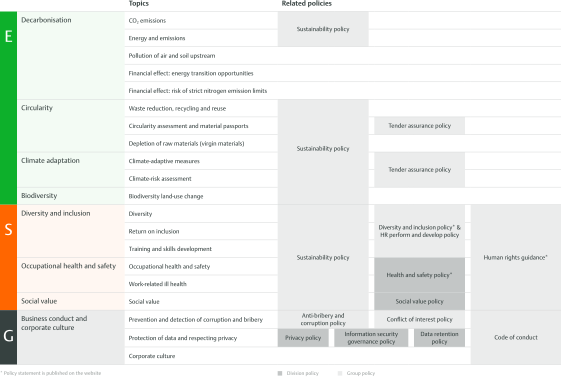
Sustainability policy
BAM is committed to the United Nations' Sustainable Development Goals
framework. The policy applies to BAM’s own operations and sets relevant criteria for the selection of suppliers. BAM encourages subcontractors and suppliers to have relevant sustainability policies in place and to adhere to any prescriptive (project) sustainability requirements so that they are in compliance with BAM’s policy or any client sustainability requirements, and to be in compliance with relevant environmental protection laws and regulations.
HR policies
BAM puts its employees at the forefront of the strategy, ensuring that everybody in BAM lives its values, that leadership drives BAM forward, that BAM fosters diversity and inclusion, that BAM’s employees thrive and grow, and that BAM builds communities with a focus on safety and innovation.
Policies related to business conduct
BAM’s code of conduct sets expectations and commitments to uphold BAM’s values and responsibilities to do things right. The
policy framework establishes the governance structure, addresses key risk areas and ensures compliance with relevant laws and regulations.