Climate change (ESRS E1)
Climate change mitigation relates to BAM’s impact and actions related to the general process of limiting the increase in the global average temperature to 1.5 degrees Celsius above pre-industrial levels in line with the Paris Agreement. This chapter covers disclosures related to Greenhouse gases (GHG), disclosure requirements on how BAM addresses its GHG emissions as well as the associated transition risks. The disclosure requirements related to energy cover the types of energy consumption that are relevant for BAM.
Climate change adaptation relates to BAM’s processes of adjustment to actual and expected climate change and covers disclosure requirements regarding climate-related hazards that can lead to physical climate risks for BAM and the assets BAM builds, including the adaptation solutions to reduce these risks. It also covers physical and transition risks arising from the needed adaptation to climate-related hazards.
Disclosures are related to the following material impacts, risks and opportunities as identified through BAM’s double materiality assessment process, refer to full details in chapter 6.1.
|
Material impact, risk or opportunity |
||
|
Climate change mitigation |
||
|
GHG emissions: Scope 1 and 2 |
(OO) |
Negative impact |
|
GHG emissions: Scope 3 |
(VC) |
Negative impact |
|
Energy transition |
(VC) |
Opportunity |
|
Climate change adaptation |
||
|
Climate adaptive solutions |
(OO) |
Positive impact |
The disclosures in this section should be read in conjunction with the disclosures in chapter 6.2 on Governance, Strategy and Impact, risk and opportunity management. Further disclosure requirements incorporated by reference are:
|
Disclosure requirement |
Reference to other chapters in the 2025 Annual report |
|
ESRS Standards: General disclosure (ESRS 2) |
|
|
GOV-3 |
Integration of sustainability-related performance incentive schemes of Supervisory Board and Executive board in chapter 5.1 and chapter 5.2. |
Transition plan for climate change mitigation (E1-1)
In order to demonstrate climate leadership, BAM aims to substantially reduce emissions at a pace consistent with the 1.5°C Paris-compliant trajectory. BAM’s transition plan helps to identify and highlight good practice approaches of climate action, supported by a structured methodology to evaluate BAM’s performance and assess to what extent BAM is on track to meet our reduction targets. Key areas of corporate climate action include transparently tracking and disclosure of emissions; setting emission reduction targets; reducing own emissions and value chain emissions and in the long term taking responsibility for unabated and residual emissions through climate contributions and neutralisation.
Emission reduction targets
BAM is committed to reducing the greenhouse gas (GHG) emission intensity of its operations. BAM's decarbonisation targets (Scope 1, 2 and 3) are aligned with the 1.5 °C pathway, verified by the Science Based Targets initiative (SBTi), ensuring compliance with the latest scientific research and the goals of the Paris Agreement. The most recent update of this approval has been received in January 2025. This renewed target represented an improvement over BAM’s previous SBTi submissions and approvals from 2019 and 2021. BAM has set targets for the medium term (2026) and the long term (2030 and 2050).
In accordance with ESRS 2, Appendix B, and pursuant to the disclosure requirements under Regulation (EU) 2020/1818, which amends Regulation (EU) 2016/1011 (the Benchmark Regulation), BAM confirms that it is not subject to exclusion from an EU Paris-Aligned Benchmark (PAB). BAM’s climate change mitigation targets are compatible with the transition to a sustainable economy and with the objective of achieving net-zero by 2050.
More details on BAM's decarbonisation targets can be found in Targets related to climate change mitigation and adaptation (E1-4).
These targets have been translated into internal milestones to ensure alignment with BAM’s strategic approach. The sustainability targets are fully supported by BAM’s strategy ‘Building a sustainable tomorrow’.
BAM’s transition plan is embedded in and aligned with the overall business (financial) planning. It has been part of BAM’s yearly planning and quarterly reporting cycle already for a couple of years. Both performance measurement on the targets, as well as forward steering on business initiatives are part of this cycle. BAM has explicit roadmaps for Scope 1, 2 and 3 reduction. These roadmaps are developed continuously from a more qualitative approach towards more quantitative planning. BAM is continuously monitoring target setting and related performance and is committed to update the targets at least every five years, in line with SBTi requirements.
BAM is not using carbon offsetting as a substitute for emission reductions or to meet short and medium term emission reduction targets.
Reduction levers for own emissions
Climate change mitigation actions, decarbonisation levers and relevant changes to BAM’s portfolio to support actions are the key driver to BAM’s strategy ‘Building a sustainable tomorrow.’ The details of the transition plan are described in this section. Also BAM’s progress on EU Taxonomy aligned-revenue, CapEx and OpEx is an important proof point for an increase of more sustainable business activities (refer to chapter 6.6 for BAM’s disclosures in accordance with the Commission’s Delegated Regulation (EU) 2021/2178 on the EU Taxonomy).
BAM’s Scope 1 and 2 GHG emissions are largely dependent on the fuel used in construction equipment, company vehicles and energy efficiency of our buildings. Their year-on-year reductions are driven by BAM's ambition for emission-free construction sites and sustainable building portfolio.
The electrification of equipment is not sufficient to reach BAM’s short term GHG reduction targets, which is why BAM is also replacing conventional diesel with sustainably produced HVO. The use of HVO increased to 11 million litres in 2025 compared to 10 million litres in 2024. HVO now covers 56% (54% in 2024) of the fuel use on construction sites, saving circa 20,000 killotonnes of GHG emissions (compared to diesel use).
The replacement of fossil fuels by biofuels continues to spark debate. This discussion is focused on proving the true sustainability of apparently lower-carbon biobased fuels, which is sometimes questioned due to potential adverse impacts (e.g. land-use change) during the production of biomass. BAM has given careful consideration to the use of HVO and remains satisfied that it is a necessary and suitable transition fuel to reduce CO2 emissions in the short term. BAM sees the use of HVO as only an intermittent measure, and we are working to reduce the company's dependency on HVO for CO2 reduction, mainly by electrifying our equipment, and consider alternative sustainable energy carriers, such as green hydrogen.
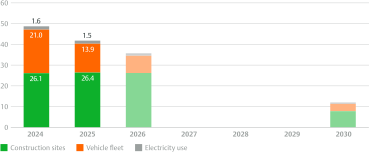
The largest source of GHG emissions in our own operations remains the fuel use on construction sites. The roadmap towards BAM’s 2026 target and further reduction in 2030 also shows that the majority of the GHG reduction is anticipated to occur at BAM construction sites, as a result of further electrification of equipment and deployment of HVO.
BAM’s main focus areas for 2026 and beyond to further reduce direct GHG emissions are:
-
Electrification of (heavy) equipment at the construction sites, vans and company car fleet (commercial vehicles and lease cars);
-
Reducing diesel use on construction sites by establishing early-stage grid connections, electrify equipment and using alternative fuels (sustainably produced biofuels) where possible. The most important measure is the use of certified sustainable HVO on BAM’s own projects which will carry on in 2026;
-
Electrifying BAM’s company car fleet and ensuring the used electricity is renewable. Due to existing lease arrangements it will take a few years before the company cars will be 100% electrified. All newly purchased vans are electric, except when operational issues prevent this due to the reasons such as limited range;
-
Use of Hydrotreated Vegetable Oil (HVO) as a renawable alternative for diesel for construction machinery, vans and trucks that haven not (yet) been electrified;
-
Working towards the procurement of 100% renewable electricity in all offices and project sites for the whole group.
The demand for sustainable HVO is growing, while the supply is not expected to rapidly grow as it depends on the availability of by products. If other sectors, such as the aviation industry, also start to use HVO as a main measure to reduce fossil fuel use, this will have the potential to substantially increase the price of HVO. For BAM, this will either mean that short term CO2 reduction targets will not be met or that additional costs will be made to cover for the price increase.
Reducing value chain emissions
Scope 3 GHG emissions are the largest contributor to BAM’s GHG footprint and a key driver of the company’s transition risks and opportunities. For further disclosures on Scope 3, refer to chapter 3.2.
BAM’s ambitious Scope 3 reduction target for 2030 underlines BAM’s commitment to reduce CO2 emissions in the value chain. Initiatives are ongoing to reduce emissions associated with the use of raw materials, including pursuing opportunities to use more sustainable materials, such as timber, recycled steel and lower carbon concrete. BAM is actively steering on underlying drivers, such as percentage of recycled steel use and percentage of lower carbon concrete use.
To reduce downstream emissions, BAM is driven by regulatory pressure, investor expectations and client demands to construct more and more low carbon assets (A+++ and A++++ label), as these have a significantly lower energy consumption during their lifespan and are related to lower financial risks such as asset stranding. BAM is increasingly delivering low and net-zero carbon assets. While in UK the Net Zero Carbon Building Standard is still under development to unify the approach for verifying net zero building claims, BAM participates in a trial with two projects: Southam College and Lyde Green School to help inform the development of the standard.
In order to pro-actively manage BAM's Scope 3 impact, sustainability considerations are integrated into the tender evaluation process to ensure that environmental, social, and life-cycle impacts are assessed alongside cost, quality, and technical performance. Sustainability criteria are established in the pre-tender stage, focusing on carbon reduction, resource efficiency, responsible sourcing of materials, and energy-efficient construction methodologies. Sustainability performance is evaluated as a weighted component of BAM's tender assessment. Final tender proposals are reviewed and approved by a multidisciplinary team, ensuring that sustainability outcomes are considered alongside commercial and technical factors.
BAM is also steering the following Scope 3 reduction drivers:
-
We are continuing and accelerating our biobased transition, primarily through our Flow housing concept and also within our Dutch construction segment;
-
Low-carbon concrete (for example GROENR beton) is one of our high priority levers. Using a low carbon alternative, such as GROENR beton, allows us to reduce around 12% of emissions per each cubic meter of concrete. In 2025, the use of GROENR concrete increased by 9.2% in the application of GROENR ready-mix concrete on projects compared to 2024. At the same time, we are cooperating with our supply chain on the innovations regarding sustainable concrete;
-
We are making asphalt more sustainable by producing it at lower temperatures, using high percentages of recycled materials, expanding innovative technologies like LEAB, and transitioning to zero-emission equipment across the entire asphalt chain;
-
Actively discussing with clients the use of alternative sustainable materials and energy concepts, based upon our internal CO2 calculations during the tender- and design process;
-
Upskilling our colleagues to lead the way regarding low-carbon design.
For our biggest materials (concrete, steel and asphalt) we are working together with our supply chain to support transition to low-carbon materials.
In the UK&I division, we have incorporated decarbonisation scoring into our preferred supplier agreement tender for precast concrete. Our goal is to engage with suppliers on a long-term basis under this agreement to support them in their decarbonisation efforts. A similar approach is planned for ready-mix concrete in 2026. To build wider industry confidence in investing in low-carbon concrete technologies, BAM has recently joined the Innovate UK / DESNZ-supported Advanced Market Commitment Initiative. This initiative aims to establish a cumulative call-off agreement for innovative low-carbon concretes, helping drive investment in these solutions. Additionally, BAM has signed a letter of support for the use of calcined clays which is a technology considered a key contributor to short-term concrete decarbonisation, provided production can be scaled effectively.
Within the Dutch division, we are working to meet the criteria set by the Concrete Agreement (Betonakkoord), which BAM signed in 2018. As part of this effort, we issued Sustainable Purchasing Instructions this year for the procurement team. These instructions require colleagues to:
-
Purchase low-carbon concrete;
-
Use secondary aggregates wherever possible;
-
Request suppliers to provide sustainability data using a predefined template;
-
Seek internal advice from experts for projects with high concrete usage (over 100 m³) to limit the environmental impact.
When it comes to steel, our main focus this year in the UK & Ireland has been on purchasing sustainable options for rebar and sheet piles:
-
Rebar: we have set maximum carbon footprint thresholds in supplier agreements, ensuring we only purchase rebar with performance below these limits;
-
Sheet piles: all sourced from EAF production.
For construction steel, no local manufacturer currently produces beams via EAF, so we are working together with the industry to accelerate this transition. We maintain close supplier engagement, collecting quarterly sustainability data and building a strong, transparent supply chain. Additionally, we advocate for governmental incentives to offset the extra costs of EAF steel, helping the industry move toward decarbonisation. One of such examples is a program called 'UK Government Procurement Policy on steel procurement' in which BAM plays an active role.
In the Netherlands, we have strong access to low-carbon steel and are steering towards 75% EAF steel by 2026. Beams produced via EAF are readily available, making it easier to integrate sustainable steel into our projects. We also promote reuse of steel wherever possible, encouraging project teams to incorporate reclaimed materials and explore EAF-produced components.
We are taking significant steps to reduce emissions from asphalt production and application. In 2025, nearly one-third of our asphalt was produced at low temperatures (Warm Mix Asphalt), combined with about 40% secondary materials. We are also expanding the use of LEAB technology across our asphalt plants, enabling lower energy consumption and CO₂ emissions. Additionally, we are scaling up cold recycling techniques, such as Bitumen Stabilised Material, which allows roads to be reused with over 95% recycled content and minimal carbon footprint. On top of that, our asphalt equipment is now more often zero-emission than diesel-powered, making construction sites increasingly emission-free without compromising quality or speed. We aim to make Warm Mix Asphalt the new standard and continue building a fully sustainable asphalt chain from production to the construction site.
In the divison United Kingdom and Ireland, the technological pathway to low-carbon asphalt and net-zero pavements like leveraging innovative carbon-sequestering aggregates, has been mapped out. Industry-wide trials are currently underway to test performance, with the goal of enabling these solutions within UK standards over the next 5-10 years. Although BAM is not directly involved in these trials, we aim to encourage clients who are open to innovative technologies to explore these approaches. At the same time, we will maximise the implementation of “approved and ready” solutions to decarbonise pavements, such as warm-mix asphalts and higher recycled content.
The Scope 3 reduction initiatives will help to bring BAM closer to its Scope 3 reduction targets, but there are also two substantial drivers to reduce BAM’s Scope 3 footprint outside of BAM’s control:
-
Decarbonisation of industry: even though we are actively supporting innvation in the supply chain, the lowering of the GHG emissions of construction materials by production process improvements is still vastly outside of our control;
-
Decarbonisation of energy grid: the grid in BAM’s home markets is gradually decarbonising and expected to further decarbonise towards 2030. A lower grid GHG emission intensity directly reduces the GHG emissions associated with electricity use of assets delivered by BAM (downstream emissions).
We aim to work towards our 2050 target through a combination of different drivers and external (inter)dependencies. BAM will continue to electrify our fleet and equipment and adopt sustainable fuels and increase the procurement of sustainable (e.g. circular and/or biobased) construction materials. Another driver within our control is to be more selective in our choices which markets we operate in. Our ability to become net zero is also depending on the drivers discussed in the previous paragraph (decarbonisation of industry and energy grid) and the development of legislative frameworks. At this stage, it is not yet possible to quantify the exact emissions reduction that can be attributed to each individual driver. However, BAM is confident that, collectively, these drivers sufficiently support the transition to become a net-zero construction company.
Measurement improvements and Scope 3 modelling
An important focus area for BAM is the improvement of the maturity of upstream emission data, particularly the emissions associated with purchased materials and capital goods.
In 2025, BAM also continued its efforts to improve the quality of measurement of Scope 3. BAM has explored several options to unlock activity data on its purchased goods and services. In the first place BAM focuses on key materials such as asphalt, steel and concrete. Activity data is obtained using supplier statements. Additionally, data from estimated cost calculation models (tender information) and data from building information modelling is used to obtain more accurate insights in our emissions. This would enable a clearer understanding and more accurate quantification of the impact of BAM’s reduction efforts on projects going forward. Data still needs to be integrated with the spend based calculations to verify completeness of the upstream emission recording, as efforts are not expected to result in a full picture of our value chain emissions. A remainder of spend data will always be needed to report on total GHG emissions.
In addition to detailing the decarbonisation levers, BAM believes it is also essential to quantify the Scope 3 expected impact for the coming years and assess whether the transition aligns with the emission reduction targets. For that reason, BAM developed a Scope 3 forecasting model in 2025, which provides preliminary insights in future scenarios and a quantification of BAM's Scope 3 roadmap going forward.
The first version of the model has been developed for both divisions. In 2025 the model has been set up with the intent to (1) apply a consolidated approach to both divisions and (2) introduce parameters so that BAM can create scenario analysis, in which certain interventions are more successful than others.
For some part of the business the quantification of reduction roadmaps, that are used to calculated potential reduction of our efforts, are not yet as developed as for other parts. Therefore, the current model is based on a significant amount of assumptions to forecast the reduction potential of certain interventions. These have not yet been validated by internal experts. Similarly, the introduction of the scenario parameters are based on desk research and the use of external/public (re)sources. These also have not yet been validated for further use. BAM intends to take the above-mentioned steps in the coming two years. We believe that the sharing of the premature insights coming from the model currently will lead to incorrect conclusions. However, with clear steps defined to progress the top-down modelling and further enhance this with bottom-up forecasting data, we expect this will improve our capabilities to steer on Scope 3 performance going forward. This will form a substantive part of maturing our climate transition plan towards a better defined net-zero pathway.
Investment and funding
The transition to a low-carbon economy requires additional investments across the construction value chain. BAM will mobilise funding to reduce emissions, strengthen climate resilience, and support innovation. By working with clients and suppliers to embed climate considerations into project proposals, procurement, and project delivery, BAM intents to share investment needs and manage transition risks together with the value chain.
BAM invests money and resources in this transition. Operational expenditures (OpEx) and capital expenditures (CapEx) in 2025 used for implementation of action plans have been included in the financial statements. A total of €60 million has been invested in electric equipment in 2025 (2024: €55 million). This information is linked to note 14 and note 15 of the financial statements. Future investments to electrify our equipment are included in BAM's financial planning. The financial impact is limited, as this is mostly achieved through generic replacement investments.
Locked-in emissions
Locked-in emissions refer to the future GHG emissions that will inevitably be released over the lifetime of an asset, product, or infrastructure due to decisions made today. Once a building is designed, materials procured, and systems installed, the emissions associated with their production, operation, and end-of-life treatment are largely predetermined at early project stages. For BAM, locked-in emissions fall into two major categories:
-
For machinery, locked-in emissions refers to future greenhouse gas emissions that become unavoidable once a company commits to owning or operating equipment with a specific energy profile. Key drivers include the equipment lifespan (often between 8-10 years for heavy machinery), engine and fuel type (diesel, hybrid, electric, biofuel-compatible), duty cycles and utilisation rates and availability of electrification solutions. Once procurement decisions are made, the emissions trajectory associated with that machinery is largely predetermined.
-
Emissions from materials and construction processes (i.e., cement, steel, insulation, transport, on-site equipment) that are committed the moment an asset is built are often emitted upfront. These embodied emissions are released prior to use-phase and cannot be reduced once construction is complete. This elevates the importance of early-stage decision-making. Also, emissions from how a building will be operated are dependent on design choices, equipment selection, and energy supply. These are spread over the asset’s lifetime, often decades. The most relevant locked-in GHG emissions are therefore related to BAM’s order book - projects that are already contracted to be designed and delivered in the coming years. In general, the order book reflects only a few years of forward-looking GHG emissions. However, there are exceptions for projects that will remain under construction until 2030 or later. These locked-in emissions could potentially jeopardise BAM’s ability to meet its GHG reduction targets. BAM is mitigating this risk by continuously strengthening its tender process to enhance the assessment of environmental impact to reduce future GHG emissions.
Retrofits, in our housing and building renovation business, have the opposite effect. They can significantly improve operational emissions when using the asset, but rarely eliminate them entirely.
Residual emissions
BAM does not consider CO2 offsetting for its current residual emissions, but instead we focus on meeting our ambitious short term reduction targets. CO2 offsetting will become relevant for our long term net zero commitment for 2050. Following the SBTi net zero standard, we have committed to a maximum of 10% offsetting of our 2019 baseline figures. BAM does not yet have a concrete offsetting plan given that 2050 is still far away, but is exploring different options, such as the opportunity for future offsetting through certification of CO2 storage in our timber projects.
Policies related to climate change mitigation and adaptation (E1-2)
A reference to the sustainability policy is in chapter 6.2 covering the sustainability practices in BAM. Further information is also available in the policy statement on the BAM website. The update of the sustainability policy is in progress.
Actions and resources in relation to climate change policies (E1-3)
In organisational terms, investments and changes have occurred in the governance of the sustainability function throughout the business. In 2025 investments in IT systems for sustainability reporting, internal training, and additional resources in the field of sustainability (reporting) have been made to reiterate BAM’s focus on the topic and commitment to develop the right capabilities for this transformation.
Material impacts, risks, and opportunities and their interaction with strategy and business model (SBM-3)
Sustainability is a key driver in BAM's business model and strategic decision making. Our aim is not only to benefit our company but also to contribute to creating a sustainable future for our clients, employees, society, and future generations. We aspire to transition our business from conventional (grey) to environmentally conscious (green). By providing sustainable solutions BAM can achieve these goals. We recognise that, while the construction sector plays a role in driving climate change, BAM also holds significant potential to support climate solutions.
BAM is uniquely positioned because we translate energy-transition ambitions into physical assets. Almost every pathway to net zero like renewables, electrification, energy efficiency, circularity, requires construction capability. The energy transition creates an opportunity for BAM's business model by allowing us to decarbonise our core offerings, enter fast-growing energy and infrastructure markets, and evolve from project-based builders into long-term providers of low-carbon, energy-efficient, and resilient built environments.
BAM has identified one material climate-related opportunity related to the construction capacity that is needed for the energy transition, also refer to the disclosure of E1-9 Anticipated financial effects of climate change. The energy transition presents a potentially material climate-related opportunity for BAM, driven by the scale and urgency of new infrastructure required to decarbonise the global economy. Large investments are essential to build renewable energy assets, expand and modernise electricity grids, deploy energy storage, and retrofit buildings for energy efficiency and electrification. BAM has the capacity, expertise, and supply chains to deliver these projects, benefiting from sustained long-term demand while directly enabling emissions reductions across power, transport, and the built environment. BAM is scaling low-carbon construction methods, adopting digital and modular techniques and upskilling the workforce to reduce carbon emissions associated with projects delivered. At the same time, BAM is expected to capture growth from the energy transition, reinforcing its role as critical enabler of climate change mitigation and by building resilient infrastructure.
In 2024 BAM had identified a physical and transitional risk on valuation of the land bank comprising of land and associated building rights. This year the impact was further assessed and quantified. BAM holds a land bank comprising land and associated building rights (for valuation details as per 31 December 2025 refer to note 19 of the financial statements). This portfolio is primarily utilised for residential development and commercial use, located across BAM’s home markets, mainly in the Netherlands. Long-term climate changes, including rising sea levels, soil degradation, and increasing average temperatures, can impact the land value. BAM has identified which part of the land is identified as high-risk based on specific scenarios. Also increased policy and regulations, i.e. the introduction of stricter building codes and zoning requirements, particularly related to carbon reduction goals, could affect the developability of the land bank.
The risk associated with the balance sheet position of BAM was not deemed material based on the current portfolio in 2025.
From a market perspective increasing demand for sustainable infrastructure may also enhance the valuation of land with potential for low-carbon developments while diminishing the value of noncompliant plots. Diversification of the portfolio to include land with lower physical and transition risk profiles is necessary going forward.
BAM is actively implementing measures to further enhance climate resilience. In addition to implementing the transition plan related to climate mitigation, BAM adopted climate-resilient infrastructure standards and actively organises engagement with stakeholders to enhance adaptive capacity in vulnerable regions. Given the nature of our project business, we did not identify activities that limit our ability to make strategic decisions in line with a transition to a climate-neutral economy, that could potentially jeopardise BAM’s ability to execute its transition plan. Given the nature of the business, BAM is well able to adjust or adapt the strategy in the short-, medium- or long term based on change in context or progress. BAM’s resilience analysis is not based on any critical assumptions or material areas of uncertainty.
Description of processes to identify and assess material climate-related impacts, risks and opportunities (IRO-1)
BAM’s strategy is also designed to address the climate resilience of the (downstream) projects and assets, through BAM’s climate adaptation strategy. In that respect, BAM specifically assesses climate-related physical risks for each of its construction projects. BAM has developed a climate scan that is applied to key projects where physical climate related risks are relevant to either the construction process or the asset itself. This climate scan makes use of the ‘klimaateffecten atlas’ (climate effects register) which is based on the fourteen climate scenarios of KNMI (Royal Netherlands Meteorological Institute) which are based on the climate scenarios of IPCC (Intergovernmental Panel on Climate Change). The most severe climate scenario used by KNMI and in BAM’s climate scan is based on RCP 6.0 (Representative Concentration Pathway, global temperature rise of 3-4°C by 2100). These assessments take into account the likelihood, magnitude and duration of the hazards as well as the geospatial coordinates.
This climate scan is applied in the early phase of a project (or tender) and based on the outcome, climate change adaptation measures are discussed with clients and in most cases implemented.
BAM’s 2026 target is to have this type of climate risk scans effectively introduced to all the large (A, B and C category) tenders. BAM uses a classification system based on the size and risk profile of its projects, ranging from A (highest classification) to E. A, B, and C projects typically represent medium to large projects. BAM’s progress towards this target in 2025 is shown in table Climate adaption in tenders.
The climate scans that BAM is executing for projects in division Netherlands are performed based on the classification of climate-related hazards included in the EU Regulation (EU) 2021/2139 (EU Taxonomy). Refer to more details on EU Taxonomy in chapter 6.6. The climate scans in the division United Kingdom and Ireland are covering the chronic and acute risks as well, however have not been checked to align with EU Taxonomy as such.
BAM also aims to reduce the damaging effect of climate change on its construction projects by delivering climate-adaptive solutions. BAM plans to offer climate-adaptive measures, enabling its clients to choose options that make their assets more climate-resilient.
Climate adaptation in tenders
|
2024 |
2025 |
Target 2026 |
|
|
% A and B tenders with climate risk scans |
100 |
89 |
100 |
|
% A and B tenders with climate adaptive measures |
96 |
89 |
100 |
|
% A, B and C tenders with climate adaptive measures |
* |
82 |
100 |
Targets related to climate change mitigation and adaptation (E1-4)
BAM has committed to reduce the GHG emission intensity of its operations. BAM has further increased the ambition level and included a net-zero target in the most recent SBTi update, ensuring that BAM’s targets are aligned with limiting global warming to 1.5° C in line with the Paris Agreement. These accelerated targets are an important driver of BAM’s strategy and have already been communicated in 2023.
The target includes specific Scope 1 and 2 targets, which are derived using market-based GHG conversion factors. BAM’s GHG reduction targets are:
-
Reduction of 80% Scope 1 and 2 GHG emission intensity by 2026 compared to 2015;
-
Reduction of 90% Scope 1 and 2 absolute GHG emissions and reduction of 90% Scope 1 and 2 GHG emission intensity in 2030 compared to 2015 (SBTi validated);
-
Reduction of 50% Scope 3 absolute GHG emissions by 2030 compared to 2019 (SBTi validated);
-
Net-zero Scope 1,2 and 3 (minimum 90% reduction compared to 2019) by 2050 (SBTi validated).
In achieving targets for 2026 and 2030, BAM does not include the offsetting of any carbon emissions nor does BAM allow any offsetting as part of meeting the Scope 1 and 2 GHG emissions reduction targets towards 2030. BAM also has an underlying Scope 1 and 2 target to purchase 100% certified green electricity by 2030. BAM has a SBTi-validated net zero target for 2050 on total GHG emissions (absolute Scope 1, 2 and 3). BAM continuously tracks the effectiveness of the BAM’s actions by internal reporting on the targets and related metrics. BAM also has set a decarbonisation-related target to maintain a CDP Climate A List position. This performance is assessed on a yearly basis.
Reporting principles and assumptions GHG emissions Scope 1 and 2 and energy consumption
BAM’s energy consumption and greenhouse gas inventory are based on the ESRS. When referring to emissions, it is important to distinguish between CO2 (carbon dioxide) and CO2eq (carbon dioxide equivalent). CO2 refers specifically to emissions of carbon dioxide, a major greenhouse gas produced primarily from burning fossil fuels. However, many other greenhouse gases, such as methane (CH4) and nitrous oxide (N2O), also contribute to climate change. To simplify reporting and analysis, these other gases are converted into CO2 equivalents (CO2eq) based on their global warming potential (GWP). CO2eq allows to express the impact of all greenhouse gases in a single, comparable metric. BAM applies CO2 equivalent conversion factors. Throughout this document, when CO2 emissions are mentioned, BAM reports its greenhouse gas emissions (GHG) as CO2 equivalent, and refers to the total of GHG emissions, unless otherwise specified.
As BAM is operating in a high climate impact sector (as listed in NACE sections A to H and Sections L, as defined in Commission Delegated Regulation (EU) 2022/1288), BAM further disaggregates the total energy consumption from fossil sources in the table Energy consumption mix. BAM has included the net revenue as presented in the Consolidated income statement as a full to calculate energy intensity and GHG emission intensity.
The proportion of total electricity consumption that is generated from renewable energy sources, such as solar, wind, hydro, and geothermal indicates the extent to which electricity used is derived from environmentally sustainable and non-polluting sources. Electricity used is recorded in kWh. Fuel use of leased and company cars can be entered in liters or kilometers and is converted to MWh. Activity data is mostly based on meter readings, invoices and supplier data. In instances where complete and accurate data are unavailable, BAM employs calculations or estimations utilising reliable methods and input data by the judgement call of the division’s experts.
The energy consumption (reported in MWh) and GHG emissions associated with BAM’s energy consumption, are calculated using conversion factors from reputable and authoritative sources, i.e. government supplied factors. The applied conversion factors differ based on the calculation:
-
Country-specific conversion factors are used for all resources, e.g. https://www.co2emissiefactoren.nl/factoren/ for the Netherlands or https://www.gov.uk/government/publications/greenhouse-gas- reporting-conversion-factors-2024 for the United Kingdom.
-
Tank-to-wheel emission factors are applied for Scope 1 emissions (well-to-tank is part of BAM’s Scope 3 footprint)
BAM reports GHG emissions based on market-based conversion factors as well as location-based conversion factors. All conversion factors are reviewed annually and updated accordingly. To achieve consistent measurement throughout the year, BAM is updating the conversion factors in the first quarter of the year. This means that if the release date of specific conversion factors is later in the year, BAM is using prior year factors (i.e. 2024 factors). Fuel and electricity provided by BAM to subcontractors is currently included in Scope 1 and 2. If fuel and electricity is used by third parties on a BAM project that BAM has not procured, then it is part of Scope 3 to avoid double counting.
For specific information regarding BAM’s operational control and BAM’s value chain, refer to chapter 6.2 No changes in the reporting scope have been triggered by aligning the Scope 1, 2 and 3 reporting definitions with those in ESRS. BAM’s Scope 1 and 2 GHG emissions all originate from the consolidated accounting group.
Energy consumption and mix (E1-5)
As energy consumption is closely related to the impact BAM has on climate change, this disclosure requirement provides more insights into the total energy consumption in absolute value, and BAM’s share of renewable energy in its overall energy mix. The current level of green electricity is at 80% (2024: 64%) of the total electricity use.
The use of purchased green energy and cleaner fuels contribute to a decrease in GHG emissions but does not tell anything about the energy efficiency of BAM. Using the absolute energy consumption, in combination with the GHG emissions, allows better insight in the development of BAM’s energy use and efficiency.
All electricity in the Netherlands is purchased from the supplier ‘Eneco’, with bundled energy attribute certificates (EAC) for 100% Dutch wind power. In 2025, BAM has further increased the percentage of green electricity in the Netherlands related to public and home EV charging through the purchase of unbundled EAC’s. The green electricity in Ireland is purchased from the supplier ‘Energia’, with bundled EAC’s for 100% wind or solar energy. In the United Kingdom and Belgium the green electricity purchased varies from region to region and sometimes even from project to project. Green (low carbon) electricity is coming from different electricity suppliers and supported by renewable energy guarantees of origin in bundled or unbundled procurement. BAM currently does not procure green electricity backed by power purchase agreements.
A large share of BAM's electricity consumption is being generated by the charging of its electric fleet. On most of BAM’s locations renewable electricity is used. In 2025 BAM has purchased Guarantees of Origin related to the electricity use for home and public charging in the Netherlands. This option supports the push towards BAM’s target of 100% renewable electricity use in 2030. As a result, BAM’s renewable electricity share has increased to 80% in 2025 (2024: 64%).
Energy consumption and mix
|
2024 |
Share of total energy consumption (in %) |
2025 |
Share of total energy consumption (in %) |
|
|
Fuel consumption from coal and coal products (MWh) |
- |
- |
- |
- |
|
Fuel consumption from crude oil and petroleum products (MWh) |
147,263 |
43.5 |
126,514 |
38.1 |
|
Fuel consumption from natural gas (MWh) |
18,010 |
5.3 |
26,645 |
8.0 |
|
Fuel consumption from other fossil sources (MWh) |
2 |
0.0 |
27 |
0.0 |
|
Consumption of purchased or acquired electricity, heat, steam and cooling from fossil sources (MWh) |
23,827 |
7.0 |
13,824 |
4.2 |
|
Total fossil energy consumption (MWh) |
189,103 |
55.8 |
167,010 |
50.3 |
|
Total consumption from nuclear sources (MWh) |
- |
- |
- |
|
|
Fuel consumption for renewable sources (e.g. biomass, hydrogen) |
106,975 |
31.6 |
107,772 |
32.5 |
|
Consumption of purchased or acquired electricity, heat, steam and cooling from renewable sources (MWh) |
41,833 |
12.4 |
56,454 |
17.0 |
|
Consumption of self-generated non-fuel renewable energy (MWh) |
765 |
0.2 |
509 |
0.2 |
|
Total renewable energy consumption (MWh) |
149,573 |
44.2 |
164,735 |
49.7 |
|
Total energy consumption (MWh) |
338,676 |
100.0 |
331,745 |
100.0 |
|
Energy intensity (total energy consumption per net revenue, MWh/€) |
0.05 |
0.05 |
Gross Scope 1 and 2 GHG emissions (E1-6)
BAM once again reduced its Scope 1 and 2 GHG emission in 2025 compared to 2024. BAM has a reached a reduction of 76% (market-based) compared to the baseline 2015. BAM’s ongoing GHG emission reduction measures such as the use of sustainable biofuels and electrification of lease fleet, and transformation to renewable electricity and electric/hybrid equipment contributed to this reduction.
Absolute Scope 1 and 2 GHG emissions per division
|
(in kilotonnes) |
2015 |
2024 |
2025 |
|
baseline |
|||
|
Division Netherlands |
42.8 |
21.7 |
15.0 |
|
Division United Kingdom and Ireland |
49.5 |
26.5 |
26.3 |
|
Other* |
92.7 |
0.5 |
0.4 |
|
Total scope 1 and 2 GHG emissions |
185.0 |
48.7 |
41.7 |
The negative impact of GHG emissions of BAM on the environment is significant, as it leads to global warming and climate change, extreme weather, rising sea levels and changes in precipitation patterns, affecting agriculture, water resources, biodiversity, and infrastructure. BAM’s reporting includes both direct GHG emissions (Scope 1 emissions originating from BAM’s own sources and leased vehicles) and indirect GHG emissions resulting from the generation of purchased electricity used by BAM, calculated with market-based conversion factors (Scope 2 emissions), and Scope 3 emissions.
Location-based method quantifies Scope 2 GHG emissions based on average energy generation emission factors for defined locations (e.g. Netherlands, UK, Ireland). Market based method quantifies Scope 2 GHG emissions based on GHG emissions emitted by the generators from which BAM contractually purchases electricity bundled with instruments, or unbundled instruments on their own. BAM’s electricity is sourced through retail supply contracts with an electricity supplier (retail green electricity).
With regard to Scope 1 and 2, BAM tracks its progress compared to base year 2015. In the baseline 2015 BAM has included the comparative figures based on the financial consolidation in the reporting year 2015. This does however include the business activities of BAM that have been divested in the year’s after 2015. The targets are based on intensity, hence the relative impact of divestments is limited.
In 2025, BAM further reduced the Scope 1 and 2 impact in absolute terms and for intensity as well. BAM’s Scope 1 and 2 GHG emissions in 2025 are 41.7 (2024: 48.7 kilotonnes), resulting in an GHG emission intensity of 5.9, compared to 7.5 in 2024. BAM has reduced its Scope 1 and 2 GHG emissions by 76% compared to the baseline of 2015.
The use of HVO has increased to 56% of total fuel consumption on construction sites (54% at year-end 2024). Direct emissions on a handful of large joint operation projects are currently a large contributor to the remaining emissions, around approximately 30% of the total Scope 1 and 2. Changes in project schedules impact the timing of carbon emission ‘rich’ activities, and hence could skew BAM’s year on year performance. In total BAM aims for a Scope 1 and 2 reduction of 90% in 2030 versus 2015.
BAM relies on the use of (certified) sustainable hydrogenated vegetable oils (HVO) to reduce the GHG emissions from its energy intensive construction processes, such as groundworks. At the moment, the additional costs of HVO are limited and most clients of BAM are willing to pay the premium.
Share of EV in BAM’s car lease fleet has increased to 82% (66% at year-end 2024), resulting in a further reduction of Scope 1 and 2 emissions. The share in EV in BAM's company vans is 17%. Further details on BAM’s energy use are disclosed in the section below.
CO2 emissions from biogenic carbon
|
(in kilotonnes) |
2024 |
2025 |
|
Biogenic carbon emissions |
27,401 |
27,309 |
|
Fuel type |
||
|
HVO 100% |
27,401 |
27,309 |
|
HVO 50% |
- |
- |
|
HVO 20% |
- |
- |
|
Total scope 1 and 2 GHG emissions |
27,401 |
27,309 |
Gross Scope 3 and total GHG emissions (E1-6 continued)
Scope 3 GHG emissions (gross) are the main component of BAM’s GHG inventory and are an important driver of BAM’s transition risk. Total Scope 3 GHG emissions in 2025 are estimated at 1,496 kilotonnes (recalculated 2024: 1,644 kilotonnes), a factor 36 larger than BAM’s Scope 1 and 2 GHG emissions. Most of BAM’s Scope 3 GHG emissions fall under category (1) Purchased goods and services and in category (11) Use of sold products. By closely monitoring BAM’s GHG emission targets, BAM continuously measures progress towards reducing GHG emissions in accordance with EU policy goals.
Despite BAM’s efforts to improve Scope 3 measurement methodology, significant uncertainties still exist in relation to the reported Scope 3 GHG emissions (including the baseline number based on the 2019 year). Details on BAM’s Scope 3 GHG emissions reporting principles and assumptions are included in chapter 3.2.
GHG emissions
|
2015 baseline* |
2019 baseline** |
2024 |
2024 recalculated**** |
2025 |
Delta 2025-2024 recalculated |
Target 2026 |
Target 2030 |
Target 2050 |
Annual % target / base year |
||
|
Scope 1 GHG emissions (kt CO2 eq.) |
n.a. |
||||||||||
|
Scope 1 emissions |
170 |
117 |
41 |
41 |
38 |
-8% |
n.a. |
n.a. |
n.a. |
n.a. |
|
|
Scope 2 GHG emissions (kt CO2 eq.) |
|||||||||||
|
Gross location based Scope 2 GHG emissions |
33 |
25 |
19 |
19 |
17 |
-12% |
n.a. |
n.a. |
n.a. |
n.a. |
|
|
Gross market based Scope 2 GHG emissions |
15 |
14 |
8 |
8 |
4 |
-100% |
n.a. |
n.a. |
n.a. |
n.a. |
|
|
Scope 1 and 2 GHG emissions (kt CO2 eq.) |
|||||||||||
|
Scope 1 and 2 location based |
203 |
142 |
59 |
59 |
55 |
-7% |
n.a. |
n.a. |
n.a. |
n.a. |
|
|
Scope 1 and 2 market based |
185 |
131 |
49 |
49 |
42 |
-17% |
n.a. |
18.5% |
n.a. |
-8% |
|
|
Scope 1 and 2 emission intensity (in tonnes CO2 eq. per € million revenue) |
|||||||||||
|
Market based Scope 1 and 2 intensity |
24.9 |
18.2 |
7.5 |
7.5 |
5.9 |
-27% |
5.0 |
2.5 |
n.a. |
-8% |
|
|
Significant Scope 3 GHG emissions (kt CO2 eq.) |
|||||||||||
|
Total gross indirect (Scope 3) GHG emissions*** |
* |
3,154 |
2,093 |
1,644 |
1,496 |
-9% |
n.a. |
1,577 |
n.a. |
-9% |
|
|
1. Purchased goods and services |
* |
1,466 |
1,363 |
944 |
952 |
1% |
n.a. |
n.a. |
n.a. |
n.a. |
|
|
2. Capital goods |
* |
117 |
108 |
77 |
85 |
10% |
n.a. |
n.a. |
n.a. |
n.a. |
|
|
3. Fuel and energy-related activities |
* |
33 |
18 |
18 |
20 |
9% |
n.a. |
n.a. |
n.a. |
n.a. |
|
|
5. Waste generated in operations |
* |
21 |
15 |
15 |
18 |
17% |
n.a. |
n.a. |
n.a. |
n.a. |
|
|
6. Business travel |
* |
9 |
6 |
6 |
2 |
-62% |
n.a. |
n.a. |
n.a. |
n.a. |
|
|
7. Employee commuting |
* |
4 |
2 |
2 |
1 |
-69% |
n.a. |
n.a. |
n.a. |
n.a. |
|
|
11. Use of sold products |
* |
1,484 |
535 |
535 |
369 |
-31% |
n.a. |
n.a. |
n.a. |
n.a. |
|
|
12. End-of-life treatment of sold products |
* |
19 |
45 |
45 |
47 |
4% |
n.a. |
n.a. |
n.a. |
n.a. |
|
|
15. Investments |
* |
- |
1 |
1 |
4 |
300% |
n.a. |
n.a. |
n.a. |
n.a. |
|
|
Total GHG emissions (kt CO2 eq.) |
|||||||||||
|
Total GHG emissions location based |
* |
3,296 |
2,152 |
1,703 |
1,551 |
-9% |
n.a. |
n.a. |
n.a. |
n.a. |
|
|
Total GHG emissions market based |
* |
3,285 |
2,142 |
1,693 |
1,538 |
-9% |
n.a. |
n.a. |
329 |
-9% |
|
|
Total GHG emissions intensity location based (tonnes CO2 eq. per € million revenue) |
* |
457 |
333 |
263 |
221 |
-16% |
n.a. |
n.a. |
n.a. |
n.a. |
|
|
Total GHG emissions intensity market based (tonnes CO2 eq. per € million revenue) |
* |
456 |
332 |
262 |
219 |
-16% |
n.a. |
n.a. |
n.a. |
n.a. |
Reporting principles and assumptions GHG emissions Scope 3
BAM’s Scope 3 inventory is based on ESRS. BAM reports its greenhouse gas emissions as CO2 equivalent. BAM’s Scope 3 estimation is based on several different data sources, methods, and assumptions. Five out of the fifteen categories are considered not applicable and/or not material for BAM, for the following reasons:
-
Category 8. Upstream leased assets: BAM’s leased assets consist of leased buildings (offices) and the lease fleet. Related emissions are already included in BAM’s Scope 1 and 2 emissions.
-
Category 9. Downstream transportation and distribution: As a construction-services business, no product undergoes downstream transportation and distribution.
-
Category 10. Processing of sold products: All products are sold in final form, with no further processing required.
-
Category 13. Downstream leased assets: The assets that are leased to other entities are constructed by BAM itself. This means the downstream emissions are already included in category (11) Use of sold products. In some occasions, a business unit owns assets that are temporarily under BAM’s management and leased to other entities. The related GHG emissions are considered not material and therefore not included in BAM’s Scope 3 inventory.
-
Category 14. Franchises: BAM does not operate a franchising business model.
The methodology, data sources and key assumption and limitations of the ten categories for which the Scope 3 emissions are estimated are listed below:
1. Purchased goods and services
This category is calculated using a spend-based method, meaning that the embodied impact of BAM’s activities is calculated by collecting data on the economic value of goods and services purchased and multiplying these by relevant secondary emission factors (e.g., industry average emissions per monetary value of goods or service). The percentage of emissions calculated using primary data obtained from suppliers or other value chain partners is therefore 0% in 2025. Vendors are classified into BAM’s procurement categories by the procurement team. BAM acknowledges a high uncertainty in this classification as a result of reliance on individual judgement and the limitation that vendors can only be classified as one procurement category. For the conversion from spend to GHG emissions, BAM uses Exiobase v3.10.1 The mapping of BAM’s procurement categories to the corresponding categories in the Exiobase database has been carried out manually based on expert judgement. Any uncategorised spend is assigned to the Exiobase category ‘Construction Works’. A dedicated tool has been developed by BAM to process the procurement data, apply the Exiobase conversion factors, and calculate the associated GHG emissions.
Exiobase 3.10.1 is the latest commercially available version of spend-based Scope 3 emission factors. These factors have been updated since 2024 to reflect the most recent data. Version 3.10.1 combines national statistics, trade data, production data, and other sources to create multi-regional input-output tables, all based on 2022 data. To ensure the correct use of the factors, BAM has adjusted its expenditure data for inflation to match 2022 price levels. These carbon factors are used to calculate Scope 3 emissions for categories 1 and 2.
The category purchased goods and services includes all emissions from BAM’s projects and a proxy for emissions from joint arrangements (joint operations and joint ventures). BAM reports the GHG emissions from joint operations on the basis of operational control (for more details on this approach in chapter 6.2).
Due to limited availability of joint operation data, BAM includes the full spend of joint operations where BAM is responsible for project administration and zero spend of joint operations where BAM is not responsible for project administration. BAM has evidence that this approach does not materially deviate from the actual spend share of BAM joint arrangements. The GHG emissions associated with the asphalt procured by BAM from the joint venture AsfaltNu are seen as relevant part of the value chain, hence included in category 1.
The GHG emissions related to third party deliveries of AsfaltNU are reported under category 15 based on the BAM-share in the joint venture.
2. Capital goods
GHG emissions from capital goods are derived from the GHG emissions from purchased goods and services. After processing in BAM’s tool, the total spend based GHG emissions includes both purchased goods and services and capital goods. The following Exiobase categories are considered to comprise capital goods:
-
Sale, maintenance, repair of motor vehicles and parts, motorcycles, motor cycles parts and accessories
-
Motor vehicles, trailers and semi-trailers
-
Machinery and equipment n.e.c. (not elsewhere classified)
-
Office machinery and computers
The GHG emissions from these categories are deducted from the category purchased goods and services and reported under capital goods.
3. Fuels- and energy related activities
This category contains the following subthemes: Upstream emissions of purchased fuels, upstream emissions of purchased electricity, transmission and distribution (T&D) losses and generation of purchased electricity that is sold to end users.
The first three of these sub themes are relevant for BAM, as BAM does not sell energy to end-users. The upstream GHG emission of fuels- and energy related activities for the first two sub themes are derived from the same fuel and energy use which form the basis for BAM’s Scope 1 and 2 emissions. The fuel and energy quantities are multiplied by country specific ‘well to tank’ emission factors to cover the upstream emissions that are not included in the Scope 1 and 2 calculation. For the third sub theme, the country specific loss rate is multiplied with Scope 2 impact data.
4. Upstream transport and distribution
GHG emissions associated with upstream transport and distribution are included in category (1) Purchased goods and services. It is not feasible for BAM to distinguish transport related emissions in the used Exiobase conversion factors.
5. Waste
GHG emissions associated with the disposal and treatment of waste are based on the waste figures that BAM also reports separately. Waste quantities are categorised by BAM’s waste processors into different waste streams and conversion factors from the ‘Emissions Factors Hub’ are used to estimate associated GHG emissions. Excavation waste is not included in this estimation as excavation waste is most often reused on site or on a different site.
6. Business travel
GHG emissions related to business travel are captured following the same process as BAM’s Scope 1 and 2 emissions. BAM captures data related to privately owned cars (refunded kilometres), air and train travel.
7. Employee commuting
GHG emissions associated with commuting by car are captured following the same process as BAM’s Scope 1 and 2 GHG emissions. Using country specific statistics, HR data and conversion factors the emissions related to the other modes of transport are calculated. These emissions are added up to determine total employee commuting emissions.
11. Use of sold products
GHG emissions from the use of sold products are activity-based values and are calculated by multiplying the energy use of BAM-delivered assets in 2025 by the asset’s lifespan and country-specific carbon intensity of the energy grid. BAM acknowledges that emissions can fluctuate significantly year-to-year depending on the projects delivered. Different approaches are used per asset type:
-
Residential Units: for residential buildings in the Dutch market, BAM estimates expected energy use by combining the BENG2 value, average energy consumption per energy label, or a reference project (depending on data availability) with the actual or national average floor area of dwellings. GHG emissions are then calculated by multiplying the asset’s expected lifespan by its annual energy intensity and the country-specific carbon intensity. A lifespan of 75 years is assumed for new homes and 25 years for renovations. As a conservative approach, BAM applies the GHG factor for electricity from an ‘unknown source’ or the national average, as the specific energy carriers for estimated energy use cannot currently be determined.
-
Offices: a project list of all assets delivered in 2025 is compiled for both divisions. In the Netherlands, energy consumption is estimated using the BENG2 value, while in the UK and Ireland, the BER value serves as an indicator of expected energy use. A lifespan of 50 years is assumed for new builds and 40 years for renovations.
-
Civil engineering assets: for assets like roads, railways, and foundations, energy consumption during use is minimal. These typically include low-energy components, such as LED lighting and electronic traffic signs. Given the low impact, BAM estimates emissions for civil assets in 2025 based on the same share as in 2024, which is 5,5%.
-
Fugitive emissions: Fugitive emissions are not included in BAM’s Scope 3 emissions. BAM has made an initial estimation based on average European leakage rates and common refrigerants in the UK and the Netherlands. These emissions are excluded from total Scope 3 calculations due to uncertainty around the Scope of projects for which these estimations are applicable.
12. End of life treatment of sold products
The GHG emissions associated with this category are calculated based on the properties and assets used to calculate Scope 3 category 11. First, the total floor area of the assets developed under category 11 is determined. This floor area, measured in square meters, is then multiplied by a BAM-specific average amount of demolition waste per square meter for each asset type.
The resulting waste mass is allocated to different end-of-life scenarios, with the distribution based on BAM’s waste treatment activities in 2025. Finally, the mass in each end-of-life scenario is multiplied by the appropriate emission factor from the ‘Emission Factors Hub’, the same source used in category 5.
15. Investments
BAM has one relevant investment in AsfaltNu. Emissions associated with the asphalt from AsfaltNu procured by BAM are already reported under category 1 in line with the approach of BAM’s joint venture partner. BAM has accounted for the BAM-share of GHG emissions of asphalt delivered by AsfaltNu to third parties, other than the joint venture partner, under category 15.
For 2025, the same methodology and assumptions were used as for 2024. Primary data was used to calculate 20% of the 2025 Scope 3 GHG emissions. BAM applied one reclassification related to the share of emissions of asphalt delivered by AsfaltNu to third parties under category 15 Investments instead of under category 1 Purchased goods and services. The reclassification concerned 3.637 t of CO2.
In 2024, BAM recalculated its 2019 Scope 3 baseline following the same methodology as for the 2024 disclosure. BAM reports this baseline in the sustainability statement for the first time in 2024 . The baseline was calculated on a ‘like for like’ basis. Only the business activities that were part of BAM in 2024 were included, meaning that the parts of Belgium and all the Germany business activities divested between 2019 and 2023 are excluded from this baseline. BAM International is only included in the 2019 baseline for upstream activities. Emission data on projects delivered by BAM International in 2019 is not available.
The Scope 3 baseline was calculated using, as much as possible, the same methodology applied in 2023 and 2024. The only significant difference is in Category 11 - Use of Sold Products. In 2019, a larger portion of this category was extrapolated due to limited data availability for certain business activities. As a result, approximately 27% of the total 2019 Scope 3 footprint is based on extrapolation, compared to 5,5% in 2025.
Scope 3 emissions represent the largest share of BAM’s total greenhouse gas (GHG) footprint, with Category 1: Purchased Goods and Services being the most significant contributor. In 2025, we updated the emission factors used in spend-based calculations to the latest Exiobase dataset (defined for 2022) and applied an inflation correction to match 2022 prices. The impact of the update of the conversion factors on upstream emissions was around -27% and the impact of inflation correction between 2022 and 2025 an additional -10%. We have also done a lot of progress in mapping our procurement categories to the correct Exiobase factors, with changes this year adding +10% to our emissions due to recategorisation of suppliers. All these updates significantly decreased the calculated emissions for Categories 1 and 2 by around 30%, compared to the methodology used last year. To ensure transparency and comparability, 2024 data was recalculated using these updates, allowing stakeholders to observe the actual year-on-year reduction independent of changes in conversion factors. It can therefore be seen that the total Scope 3 emissions in 2024 are 21% lower when recalculated using the updated conversion factors and inflation correction compared to the numbers that were disclosed in last year's report. This recalculation only impacts categories 1 and 2.
Recognizing the limitations of spend-based data, BAM is actively transitioning toward activity-based data collection to improve accuracy and decision-making. To address this method's sensitivity to price fluctuations and procurement dynamics we introduced a project-level carbon calculation method at tender stage, enabling carbon considerations before bidding decisions. Starting from the 1st of January 2025, every tender at BAM Bouw & Techniek Projecten performs a compulsory carbon calculation. This is being rolled out within other segments and in 2026 all segments will implement carbon calculation in selected business units. For further measurement improvements, refer to BAM's climate transition plan in E1-1.
We also began integrating activity-based data for key materials - including asphalt, steel, and concrete - into our internal spend-based dataset for more precise insights. As supplier data collection remains one of the biggest challenges in Scope 3 reporting, we continue to engage with our supply chain to obtain more granular, supplier-specific data, addressing this challenge and scaling the use of primary data over time.
While we are working to improve the accuracy of our reported Scope 3 figures, fluctuations can still occur due to project delivery timelines, meaning year-on-year changes do not always reflect actual reductions. Additionally, our upstream Scope 3 figures have undergone a significant update with revised conversion factors, moving from Exiobase version 3.8.2 last year to 3.10.1, which has contributed to increased accuracy in our reporting.
Looking at downstream emissions (Category 11: Use of Sold Products), results are strongly influenced by the number, type, and size of buildings delivered in a given year, as well as by methodological assumptions. Between 2024 and 2025, downstream emissions decreased by 31%.
In 2025, BAM delivered 11% less building area (m2) compared to 2024, while the carbon factor for electricity in the Netherlands decreased by 18%. In addition, individual large projects can have a disproportionate impact on reported downstream emissions in the year of delivery. For example, a large construction project can account for up to 9% of total downstream emissions in a single year. Accounting for Scope 3 downstream emissions is dependent on the delivery date, so this illustrates the inherent volatility in year-on-year figures driven by project mix and delivery timing.
Several portfolio-specific factors further contributed to the reduction. For BAM Wonen, last year’s calculations were based on an assumed average apartment size of 118 m². In 2025, actual apartment size data became available, revealing that many apartments were significantly smaller, in some cases as small as 22 m². Furthermore, lower delivered building area by Bouw & Techniek compared to last year and the delivery of a major project within Specials with an excellent energy performance rating further contributed to the observed reduction.
These reductions were partially offset by developments in BAM Belgium. In 2024, emissions were extrapolated, whereas in 2025 activity-based data was used. This methodological change led to a reported increase in downstream emissions for Belgium, which counterbalanced some of the reductions achieved elsewhere, particularly those driven by BAM Wonen.
Overall, the 31% decrease in downstream emissions reflects a combination of reduced delivery volumes, improved energy performance of the delivered projects, and more accurate, activity-based data, alongside expected volatility linked to project mix and delivery timing.
In total, BAM’s Scope 3 emissions are reported 53% lower than in our base year 2019. This is a promising result, but not representative in terms of BAM’s reduction efforts in our portfolio. BAM intends to review its Scope 3 targets to make sure the targets remain ambitious and effective. In the meantime, we focus on our efforts to meeting our 2030 target, as we anticipate that we need to compensate for increased emissions due to an uptake of delivered projects and business growth in the coming years, and continue to work towards our net-zero ambition for 2050. For details on our pathway to net zero, please refer to the Climate Transition Plan in chapter 6.3.
Anticipated financial effect of climate change (E1-9)
The energy transition presents a potentially material climate-related opportunity for BAM, driven by the scale and urgency of new infrastructure required to decarbonise the global economy.
Energy transition related revenue were around 15% of total revenue in 2025, of which one third in division United Kingdom and Ireland and two-third in division Netherlands, and growth is expected to continue. Energy transition related revenue includes projects regarding converter (land) stations and high and low voltage grid upgrades, energy efficient homes and buildings, including refurbishing, EV charging solutions and the partnership with Rolls Royce for Small modular nuclear reactors (SMR’s).
A strong demand in these markets is expected for 2030-2035. Priority of governments in the Netherlands, United Kingdom and Ireland to improve the energy security for the future is high. The plans are backed by substantial investment plans of grid operators, which prefer to secure capacity via collaborative frameworks and long-term contracts. UK government backs plans for GBP 70bn investments in 2026-2031. In division Netherlands, BAM had recent contract wins in this market, for example the long-term contracts for Enexis in Limburg and Noord Brabant. There are several projects in tender award phase for 2026 and beyond.
BAM invested in capex and workforce upskilling to expand capacity in renewable energy, grid infrastructure construction, energy-efficiency retrofits of existing buildings and EV charging projects.