6.6 EU taxonomy

The EU taxonomy for sustainable activities, i.e. ‘green taxonomy’, is a classification system to clarify which economic activities are environmentally sustainable, in the context of the European Green Deal, a set of policy initiatives by the European Commission supporting the ambition of the EU to be climate-neutral by 2050. The EU taxonomy was adopted by the European Union with Regulation 2020/852, and requires BAM to assess and disclose the percentage of environmentally sustainable economic activities for the proportion of revenue, capital expenditures and operational expenditures.
In line with the most recent amendments to the EU Taxonomy - specifically the version updated following the Omnibus Delegated Act, published in the Official Journal of the European Union on 8 January 2026 and entering into force on 28 January 2026 - we will make use of the available relief measures under the revised reporting framework. Under this updated framework, the separate reporting templates for nuclear energy have been removed, and related information is now captured on an aggregated level within the general templates. As a result, we will not be disclosing a standalone nuclear energy table. We will however not apply the materiality relief introduced in the amended Taxonomy Regulation. While the updated framework allows undertakings to classify economic activities as non‑material when they collectively represent less than 10% of turnover, CapEx, or OpEx, applying this rule in our case would render most of our activities immaterial. Such an outcome would not present a meaningful or representative view of our economic activities or sustainability profile.
The EU taxonomy comprises six environmental objectives to identify sustainable economic activities: climate change mitigation (CCM), climate change adaptation (CCA), the sustainable use and protection of water and marine resources (WTR), the transition to a circular economy (CE), pollution prevention and control (PPC), and the protection and restoration of biodiversity and ecosystems (BIO). An economic activity is defined as environmentally sustainable if it meets the technical screening criteria.
BAM has completed an eligibility assessment of its activities and for the eligible activities BAM assessed alignment with the EU taxonomy.
The assessment process has been executed under the supervision of the Executive Committee, and led by the Sustainability Reporting team with the support of the relevant functions, such as sustainability and finance.
The assessment covers all countries in which BAM operates and is carried out using the five steps presented in the figure on the right.
BAM has classified all the economic activities across its portfolio in the following three categories: eligible-aligned, eligible-not aligned, and not-eligible.
The current EU taxonomy assessment is based on BAM’s interpretation of EU taxonomy guidelines, including the latest published Environmental Delegated Act. BAM recognised that the regulation is continuously being developed, hence some elements are open to interpretation by the industry and other parties. This will potentially affect BAM’s interpretation of the criteria going forward, and therefore the outcomes of taxonomy eligibility and alignment.
Reporting principles and assumptions - EU taxonomy
The EU taxonomy requires companies to examine whether an economic activity is included in the Delegated Regulation 2020/852 by the European Commission (eligibility) and whether or not these eligible economic activities are environmentally sustainable (alignment).
BAM classifies its activities in the following three categories: eligible-aligned, eligible-not aligned, and not-eligible.
Eligible-aligned: this refers to an economic activity that simultaneously meets the following three conditions:
-
it is explicitly included in the EU taxonomy regulation for its substantial contribution to one of the six objectives of the EU taxonomy;
-
it meets the substantial contribution criteria in the EU taxonomy regulation for this specific environmental objective;
-
it meets all DNSH criteria;
-
BAM complies with the minimum safeguards.
Eligible-not aligned: this refers to an economic activity that:
-
is explicitly included in the EU taxonomy regulations for its substantial contribution to one of the six objectives of the EU taxonomy; but
-
it does not meet the specific criteria in the EU taxonomy regulation for these specific environmental objectives; or
-
at least one of the DNSH conditions is not met; and/or
-
BAM does not comply with the minimum safeguards.
Not eligible: this refers to an economic activity that has not (yet) been identified by the EU taxonomy as a substantial contributor to one of the six objectives of the EU taxonomy.
Definition of KPIs
The basis for the calculation of the EU taxonomy eligibility and alignment metrics for respectively revenue, capital expenditure and operational expenditure are based on the following definitions:
Revenue: revenues accounted for in the consolidated financial statement as further defined in note 6 of the financial statements. Intercompany revenue is eliminated and is not taken into account for the assessment of eligibility. Full reconciliation of the project list used for the eligibility and alignment calculation is performed to ensure accuracy and completeness of the numbers included and prevent the risk of double counting.
Capital expenditure (capex): additions to tangible and intangible assets accounted for in the consolidated financial statements under IFRS during the financial year, considered before depreciation, amortisation and any re-measurements, excluding goodwill (included in notes 14, 15 and 16 in the Financial Statements). The capex cover the costs accounted for in accordance with IAS 16 (Property, Plant and Equipment, IAS 38 (Intangible assets) and IFRS 16 (Leases). Any leases that do not result in the recognition of a right of use asset are not accounted for as capex.
Operational expenditure (opex): direct non-capitalised costs recorded in the consolidated income statement under IFRS that relate to research and development, building renovation measures, short-term lease, maintenance and repair (excluding expenses reported as raw materials and consumables used), and any other direct expenditure relating to the day-to-day servicing of assets or Property, Plant and Equipment (PP&E). Because the definition under the Delegated Act is taken into account to calculated total opex, the numbers differ from the figures presented under the heading ‘operating expenses’ in the financial statements.
The calculation of the financial metrics associated with each economic activity was performed relying on a centralised process, where sustainability information is mapped to financial information in a single database. The financial information was collected from the Group’ reporting system. Sustainability information is obtained from the CRM system and enriched with management information on the environmental performance of the economic activities. Procedures and assumptions were documented, including details, examples and substantive evidence of the assessment, in order to complete a reliable estimate of the eligibility and alignment assessment. In order to arrive at the EU taxonomy KPIs, BAM mapped its financial performance to the relevant EU taxonomy eligible and aligned economic activities.
Minimum social safeguard requirements
BAM has verified that the eligible economic activities are carried out in compliance with the minimum social safeguards, including the human right due diligence process and risk assessment.
Revenue - eligibility methodology
The revenue KPI is calculated based on the proportion of net revenue generated from projects. Revenue of joint ventures (as reported in note 17 of the Financial statements) is not included in the scope of the assessment. The analysis with regard to taxonomy eligibility was carried out on data per project. The EU taxonomy provides descriptions of eligible economic activities that belong to one of the six objectives of the EU taxonomy.
The activities of BAM that are eligible under the EU taxonomy are all eligible under activities within the objectives climate change mitigation, climate change adaptation, and/or the transition to a circular economy.
Revenue - alignment methodology
For the purpose of the taxonomy-alignment assessment, BAM clustered projects based on the nature of the activity and similarity in operational and technical criteria to assess compliance with the technical screening criteria in the EU taxonomy. Based on the BAM’s strategic focus, preliminary screening and internal identification of potential ‘green’ revenue with different stakeholder groups, BAM selected multiple clusters for which the alignment assessment was performed. Dependent on the granularity of the criteria, the assessments were performed on a country, business or project level.
BAM’s alignment assessment includes the analysis of all substantial contribution criteria and DNSH criteria for the relevant objectives. In the assessment BAM:
-
Describes the context and application in BAM’s context;
-
Substantiates and provides available documentation to support the claim on whether an activity meets the criteria, either on a project, or on an activity level, dependent on the nature of the criteria;
-
Reaches a conclusion on the alignment based on the available substantiation;
-
Evidences adherence to the minimum safeguards on a Group-wide level.
Capex - eligibility and alignment methodology
The eligibility scan for capital expenditures in 2025 (capex additions) was performed in line with the eligibility scan for revenue. For all expenditures, BAM determined if there was a specific allocation possible to an economic activity. Most capex, such as (electric) equipment or cars, tower cranes, surveying equipment or cabins is associated with multiple economic activities.
Eligibility for these additions is determined based on the proportion of the capital expenditure associated with taxonomy-eligible activities on a business level. Capital expenditure by joint ventures (as reported in note 17 of the Financial statements) is not included in the scope of the assessment.
The capex alignment assessment is based on three possible alignment scenarios:
-
Capex is related to assets or processes that are associated with taxonomy-aligned economic activities;
-
Capex is part of a Capex-plan as defined in the regulation to expand taxonomy-eligible economic activities to become taxonomy-aligned (subject to conditions);
-
Capex is related to the purchase of output of aligned activities.
The aligned capex related to the first scenario has been calculated based on a pro-rata basis related to the revenue of the aligned economic activities per business. For the assessment and disclosures in 2025, BAM has allocated the capex to the economic activities mapped to the revenue KPI. Hence, alignment criteria applied to capex are equal to the criteria applied for the related economic activity. For example, with respect to investments in electric cars, BAM has assessed the alignment of capex in the context of the revenue generating activity it was allocated to. BAM has not included specific capex plans for the capex alignment assessment of 2025, because the plans for improvements do not (yet) constitute a plan to reach alignment fully.
Part of the aligned capex is based on the third category where BAM proved alignment on the capex investment itself and reported the invested amount as aligned capex.
Opex - eligibility and alignment methodology
The expense accounts identified to determine operational expenditures according to the EU taxonomy definition are the following:
-
Repairs and maintenance;
-
Short-term leases (< 12 months);
-
R&D expenses.
For repairs and maintenance, eligibility is determined on the basis of the activity description in the general ledgers. For the annual rent expenses related to short-term leases and R&D expenses, eligibility is calculated on a pro-rata basis related to the revenue eligibility of the activities per business.
Conclusion of the assessment
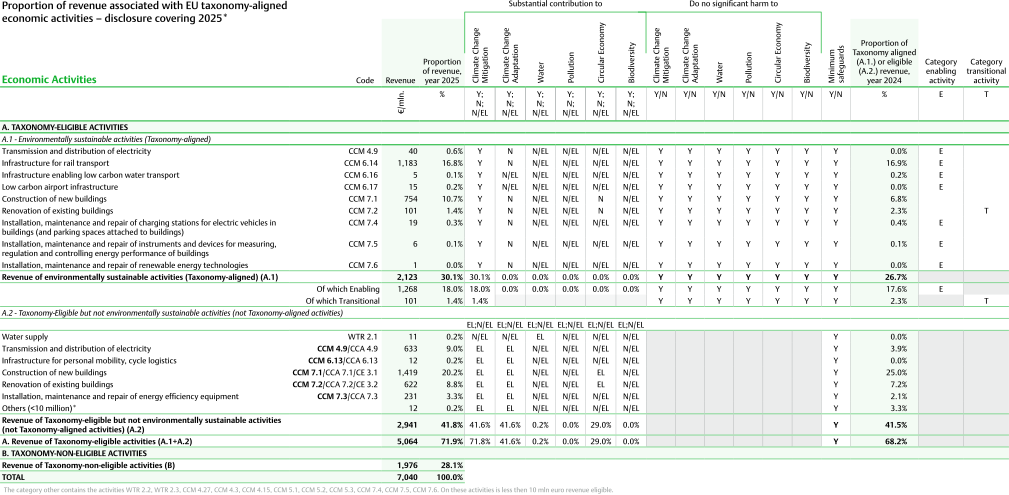
Aligned revenue in 2025 of 30% has increased compared to last year (2024: 27%). Mainly caused by shifts in portfolio and improved availability of evidence. Key insights from the assessment of the technical screening criteria have been shared within the business to further enhance BAM’s knowledge on building sustainably.
Revenue, capital expenditure (capex) and operational expenditure (opex)
Revenue - eligibility outcome
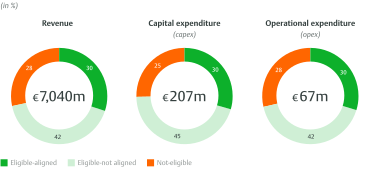
In 2025, 72% of BAM’s revenue is eligible under the EU taxonomy, compared to 68% in 2024 (previously reported: 85%). The drop in last year's eligibility percentage is due to the fact that we have incorrectly claimed eligibility for our revenue for the activities CCA 6.15, CCA 6.16 and CE3.14 in last year's disclosure. During the current‑year review, BAM reassessed its position, informed by updated clarification from the European Commission. According to the Commission’s Q&A FAQ 5 (Publications Office) and FAQ 19 (link), turnover from adapted activities cannot be recognised as Taxonomy‑eligible, as such activities - once made climate‑resilient - may or may not provide environmental benefits and therefore do not constitute eligible revenue under the EU Taxonomy framework. We are therefore correcting our approach and no longer including these activities. The outcome is that the prior‑year eligible revenue percentage has been restated from 85% to 68% to correct the inappropriate inclusion of turnover related to adapted activities. Details per activity are disclosed in the EU Taxonomy tables.
Project revenues reported as not-eligible include economic activities related to electrical installations (including fibre cables for homes), data networks, earthworks, drill and blast projects. In line with last year, BAM reported activities such as the ground investigation works for planned wind farms and the construction of cement bases of wind farms as not-eligible.
Revenue - alignment outcome
In its alignment assessment, BAM obtained substantial evidence for meeting the relevant criteria. In 2025, BAM has aligned revenue, related to specific projects or businesses, in the following activity categories:
-
Transmission and distribution of electricity (Netherlands) - CCM 4.9;
-
Infrastructure for rail transport (Netherlands and United Kingdom) - CCM 6.14;
-
Infrastructure enabling low carbon water transport (Netherlands) - CCM 6.16;
-
Low carbon airport infrastructure (Netherlands) - CCM 6.17;
-
Construction of new buildings (Netherlands), including both residential and non-residential buildings - CCM 7.1;
-
Renovation of existing residential buildings (Netherlands) - CCM 7.2;
-
Installation, maintenance and repair of charging stations for electric vehicles in buildings (Netherlands) - CCM 7.4;
-
Installation, maintenance and repair of instruments and devices for measuring, regulation and controlling energy performance of buildings (Netherlands) - CCM 7.5;
-
Installation, maintenance and repair of renewable energy technologies (Netherlands) - CCM 7.6.
The largest part of BAM’s aligned revenue in 2025 is coming from the projects related to the infrastructure for rail transport (EU taxonomy CCM 6.14) in the Netherlands and United Kingdom. This outcome is similar to last year.
Within EU Taxonomy activity CCM 7.1, the amount of Taxonomy‑aligned revenue has increased compared to the previous year. This rise is mainly the result of a greater number of projects assessed in 2025. BAM collects evidence against the technical screening criteria for each relevant project individually. BAM views the higher number of assessed projects as a positive step, as it enables the reporting of more sustainable revenue. However, this increase alone does not yet allow BAM to conclude that projects are, in general, being designed and executed in a more sustainable way. Improving the completeness and quality of data collection remains the primary challenge for further increasing the alignment percentage within this activity.
In addition to the residential projects, the assessment also resulted in aligned non‑residential revenue in CCM 7.1 and CCM 7.2. The assessment shows that while many non‑residential projects meet the contribution criteria and most of the DNSH requirements, achieving EU Taxonomy alignment is significantly more feasible when a project starts with a clear intention to align. When alignment objectives are embedded from the outset, it becomes easier to make the right design and execution choices throughout the project lifecycle. Conversely, projects that are already underway - without this early focus - tend to be harder to align, as key decisions may have been made before Taxonomy requirements were considered.
BAM has aligned revenue on the activity in EU taxonomy article CCM 6.16, these are the projects that are installing the infrastructure to provide vessels at berth with shore-side electrical power.
Alignment under CCM 6.17 is for instance related to the construction work on the Schiphol A-pier. It involves the construction and completion of a new, state‑of‑the‑art passenger pier that will add 55.000 m² of space and eight new gates, including three suitable for the largest aircraft, making it Schiphol's most sustainable pier.
Under CCM 4.9 we have aligned several energy transition projects, for example IJmuiden Ver Beta and IJmuiden Ver Gamma - which refer to the construction of two converter stations, being built by our Dutch infrastructure business on the Maasvlakte, commissioned by TenneT. These converter stations form a crucial part of the Netherlands’ offshore wind energy infrastructure.
The aligned revenue in CCM 7.4, CCM 7.5 and CCM 7.6 is mainly related to activities where BAM installs charging stations for electric vehicles, smart meters in buildings, maintenance and replacement of building services such as heating or ventilation systems and renewable energy technologies within buildings.
Capex - eligibility and alignment outcome
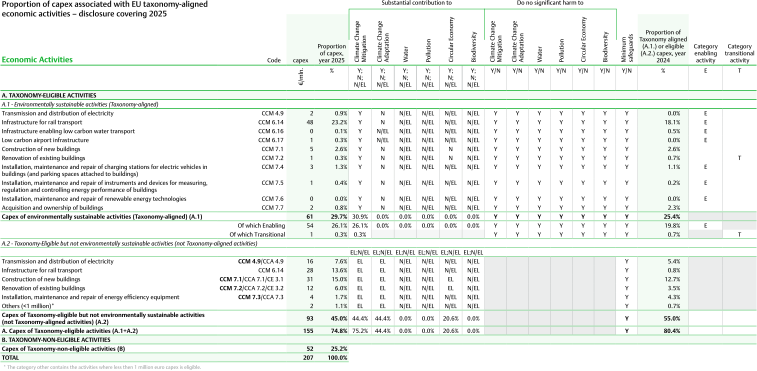
The proportion of Capital Expenditure (CapEx) in 2025 that is eligible-aligned is 30% (2024: 25%), 45% was eligible for, but not aligned with the EU taxonomy, and 25% of BAM’s capex in 2025 was determined to be not eligible. Investments in 2025 that classify as aligned under the EU taxonomy include investments in equipment regarding the construction of BAM’s aligned activities under climate change mitigation, mainly related to the rail infrastructure activities. BAM used a pro rata allocation to the economic activities for most capex investments, to determine eligibility and alignment for the year 2025.
The investments related to the residential houses and the sustainable timber housing are considered to be fully aligned under the EU taxonomy, on the basis that revenue related to these residences can be aligned. Also the amount of investments for BAM’s own buildings are not pro rata allocated to the economic activities, but reported on CCM 7.7 Acquisition and ownerships of buildings. BAM assessed the investments in their own buildings on alignment. These investments are eligible under CCM 7.7 and 41% of them is aligned on this EU taxonomy activity.
Opex - eligibility and alignment outcome
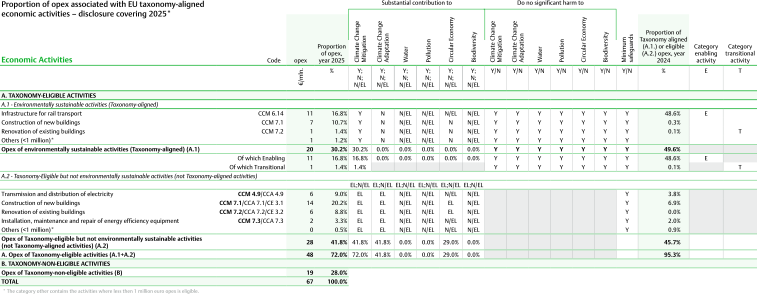
The proportion of Operational Expenditure (OpEx) in 2025 that is eligible-aligned is 30% (2024: 49%), 42% was eligible for, but not aligned with the EU taxonomy, and 28% of BAM’s opex in 2025 was determined to be not eligible.
As the opex definition in the EU taxonomy is very narrow, this KPI is less significant in the light of BAM’s business model. The percentages are estimated based on a pro-rata basis related to the revenue of the aligned economic activities in order to determine eligibility and alignment for the operational expenditures in 2025.
Operational expenditure in 2025 that classifies as eligible-aligned with the EU taxonomy, include for example the short term lease expenses, pro rata, of BAM’s rail business and R&D expenses for aligned activities.
Verification of compliance with minimum social safeguards
BAM has verified that the eligible economic activities are carried out in compliance with the minimum social safeguards, including the human right due diligence process and risk assessment for BAM. The following topics have been identified:
-
Human right policies;
-
Human right impacts;
-
Human right communications;
-
Grievance mechanisms;
-
Consumer interests;
-
Bribery and corruption;
-
Fair competition;
-
Taxation.
BAM assessed the steps of the due diligence process described in the minimum social safeguard requirements.
-
Embed responsible business conduct into policies and management systems;
-
Identify and assess adverse impacts in operations, supply chains and business relationships;
-
Cease, prevent or mitigate adverse impacts;
-
Track implementation and results;
-
Communicate how the topics and related measures are addressed.
Further details on human rights due diligence processes are included in chapter 6.4.
Eligible and aligned activities per objective and disclosure of specific activities
Proportion table shows that most of the aligned revenue of BAM is contributing to the EU taxonomy objective of climate change mitigation. BAM’s revenue is eligible on the objectives climate change mitigation, climate change adaptation and the transition to a circular economy. The table also shows the proportion of capex and opex that is aligned and eligible per objective.
Proportion Table of Revenue, Capex and Opex
|
Proportion of revenue/ |
Proportion of capex/Total capex |
Proportion of opex/Total opex |
||||
|
(in%) |
Taxonomy-aligned per objective |
Taxonomy-eligible per objective |
Taxonomy-aligned per objective |
Taxonomy-eligible per objective |
Taxonomy-aligned per objective |
Taxonomy-eligible per objective |
|
CCM |
30 |
72 |
30 |
75 |
30 |
72 |
|
CCA |
0 |
71 |
0 |
74 |
0 |
72 |
|
WTR |
0 |
0 |
0 |
0 |
0 |
0 |
|
CE |
0 |
41 |
0 |
24 |
0 |
42 |
|
PPC |
0 |
0 |
0 |
0 |
0 |
0 |
|
BIO |
0 |
0 |
0 |
0 |
0 |
0 |