Resource use and circular economy (ESRS E5)
A circular economy is an economic system designed to keep the value of products, materials, and resources in use for as long as possible. It promotes efficient production and consumption, reduces environmental impact, and minimises waste and hazardous substances throughout the entire lifecycle - guided by the waste hierarchy. The goal is to maximise the value of technical and biological resources by enabling durability, reuse, refurbishment, and recycling.
BAM focuses on the reduction of non-biobased virgin materials. Specifically, the focus is on reducing the consumption of primary materials such as concrete, steel, and asphalt, known for their substantial environmental impact. BAM aims to replace these with bio-based alternatives or secondary materials that are reused or recycled.
Waste management has been part of BAM’s operations for many years. Waste is categorised into four categories: construction, office, excavation, and demolition. BAM has direct influence over construction and office waste, which are materials brought to construction sites and products used in offices. These streams are the current focus of BAM’s waste reduction targets.
BAM also embeds circular principles in its designs. By developing buildings and infrastructure that apply circular practices, BAM contributes to a system where resources are used efficiently and sustainably.
Disclosures are related to the following material impacts, risks and opportunities as identified through BAM’s double materiality assessment process, refer to full details in chapter 6.1.
E5 Resource use and circular economy
|
Material impact, risk or opportunity |
||
|
Resource use |
||
|
Depletion of raw materials |
(VC upstream) |
Negative impact |
|
Waste reduction (hazardous and non-hazardous waste) |
(OO) |
Negative impact |
|
Waste re-use and recycling |
(OO) |
Positive impact |
|
Resource use |
||
|
Circular design |
(OO) |
Positive impact |
The disclosures in this section should be read in conjunction with the disclosures in chapter 6.2 on Impact, risk and opportunity management.
Description of the processes to identify and assess material resource use and circular economy--related impacts, risks and opportunities (IRO-1)
In 2024, BAM has screened its business activities in order to identify its actual and potential impact. Based on internal consultations with subject matter experts, and consultations with key parties in BAM’s supply chain, the relevant activities have been identified. BAM further discloses the assumptions and tools used in the impact assessment (see chapter 6.1).
Policies related to resource use and circular economy (E5-1)
BAM’s ability to meet its sustainability ambition related to resource use and circular economy is driven by the organisation's responsibilities described in the sustainability policy:
-
Make efficient use of resources (such as energy and water).
-
Optimise design to minimise the amount of materials used.
-
Consider the use of sustainable alternatives to conventional building materials, such as biobased (timber) and recycled materials. And only procure 100% certified sustainable timber.
-
Avoid waste of materials and separate remaining waste streams.
-
Support the use of materials passports and circularity assessment on projects.
The policy addresses both the standards for BAM’s own operations as well as relevant criteria for the selection of suppliers. It includes that BAM ensures that subcontractors and suppliers have relevant sustainability policies in place and adhere to any prescriptive (project) sustainability requirements to meet compliance with this policy or any client sustainability requirements and ensures subcontractor and supplier compliance with relevant environmental protection laws and regulations.
Actions and resources related to resource use and circular economy (E5-2)
Application of circular business practices are evidenced by the development of BAM’s wooden housing concept Flow. Flow also showcases higher levels of resource efficiency in use of industrialisation and biological materials (timber). Another example that evidences BAM’s contribution a circular economy is the development of cold-use asphalt in BAM’s Dutch infrastructure business activities.
Initiatives in 2025 also focused on the innovative solutions to reduce waste. In division Netherlands for example, this is done with other partners to develop a biobased fire protection board made from recycled timber waste. Another example is the using of what would be concrete waste to create flexible gryones place on river sides to minimise erosion. In division United Kingdom and Ireland, a plan to reduce waste accumulated at the end of the project has been developed to re-use waste throughout the duration of the project.
Furthermore regarding material use, BAM’s aim was to establish a baseline and reduction path for the largest material categories in 2025, which will continue in 2026. For steel, a draft roadmap has been finalised, for concrete and timber work is still in progress.
All actions and initiatives as described above are a part of BAM's ongoing operations and therefore have no additional financial resources allocated from either Capex or Opex.
Targets related to resource use and circular economy (E5-3)
As part of BAM’s long term strategy, the following targets are set linked to the increase of circular project design:
-
2030: A, B, C and industrialised projects with design in their scope to use the material passport
-
2030: A, B, C and industrialised projects with design in their scope to use the circularity assessment
In relation to the waste hierarchy, BAM’s targets to the minimise primary raw materials and use renewable resources are:
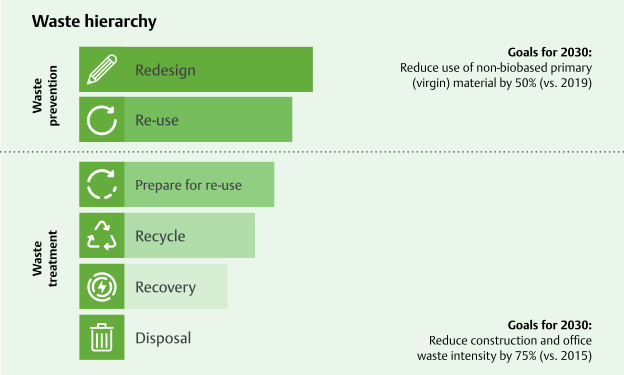
BAM tracks construction and office waste performance against a 2015 baseline established using the respective financial consolidation. This included business activities that were divested after 2015, whereas current-year reporting excludes divested businesses from the reporting scope. Since the targets are intensity-based (tonnes of waste per € million revenue), not reinstating the 2015 baseline for divestments has limited impact. The targets presented are voluntary and not required by legislation. The reduced use of non-biobased primary material prompts the use of biobased materials (e.g. timber and straw insulation). BAM has considered how this may impact biodiversity loss, also in light of Biodiversity (ESRS E4). Sustainable sourcing is a key element in BAM’s strategic approach to (biobased) material use. In the paragraph below and in Biodiversity (ESRS E4) BAM discloses the assessment and potential negative impacts of (biobased) material use.
Resource inflows (E5-4)
Resource depletion is the exhaustion of raw materials within a region. Resources are commonly divided between renewable resources and non-renewable resources. Use of either of these forms of resources beyond their rate of replacement is considered to be resource depletion. BAM has a negative impact by direct resource use on the environment and people; depending on how and where the resources are sourced, as well as how BAM uses them. For example, if BAM sources its materials unsustainably or in a way that causes pollution or habitat destruction, it can have a negative impact on the environment and local communities.
Assessing BAM’s resource inflows, it mainly concerns materials used within BAM’s own operations and along its upstream value chain. Key raw materials for BAM are (ready-mix) concrete, timber, asphalt and steel.
BAM reports the amount of materials used and the recycled content of these materials used. Specifically for timber (biological material), the percentage of sustainable sourcing is disclosed, see 99.8.
Reporting principles and assumptions primary materials (resource inflows)
BAM uses multiple methods of collecting data for the usage of materials:
-
measured data – based on suppliers’ reports, specifications from invoices or any other method where the quantities of materials are being physically measured;
-
calculated data – based on the cost of the materials and average price per unit of the material;
-
estimated data – if measuring or calculation is not possible due to limited information, it is possible to estimate the quantities of materials by applying a specific ratio.
Material consumption is determined using supplier reports when available. This data is extrapolated to cover all suppliers. For the remainder of the material use a spend based approach is used, which results in high estimation uncertainty for this specific information. The results are verified against BAM’s procurement data, and with BAM’s internal and external experts. The recycled content was determined based on information provided by suppliers and industry averages.
Asphalt: High reliability - dashboarding with integration to supplier data (cumulative).
Timber: Medium reliability - supplier reports available, extrapolated based on spend.
Concrete: Limited reliability - partial supplier reports available, largely extrapolated based on spend.
Steel: Limited reliability - partial supplier reports available, largely extrapolated based on spend.
The basic reporting unit for timber and concrete is set to cubic meters. For asphalt and steel BAM reports in tonnes. Sustainable timber has been classified in several categories: FSC 100%, FSC mix, PEFC mix, other certificates and not certified.
Material consumption
|
(in tonnes) |
2024 |
2025 |
|
Ready mix concrete |
1,436,602 |
1,659,266 |
|
of which: recycled content |
39,658 |
68,494 |
|
of which: % recycled content |
2.8 |
4.1 |
|
Asphalt |
653,978 |
703,384 |
|
of which: recycled content |
195,374 |
216,575 |
|
of which: % recycled content |
29.9 |
30.8 |
|
Steel |
167,176 |
163,852 |
|
of which: recycled content |
112,531 |
110,526 |
|
of which: % recycled content |
67.3 |
67.5 |
|
Timber |
15,759 |
25,024 |
|
Certified sustainable timber |
||
|
Sustainable timber (in % of total timber) |
99.2 |
99.8 |
|
Organisational coverage (in %) |
93 |
91 |
|
Total weight of materials |
2,273,515 |
2,551,526 |
|
Total weight of recycled materials |
347,563 |
395,595 |
The 2024 ready mix concrete has been restated to correct for a prior period error as data on pre-fabricated concrete for division Netherlands was unintentionally left out of the calculation. This is discussed further in chapter 6.2 Changes in preparation of sustainability information and reporting of prior period errors.
Timber plays a crucial role in minimising the use of non-biobased materials. BAM has committed to using only certified sustainable timber for its projects, as part of its agreement with FSC Netherlands.
BAM achieved a certified sustainable timber use of 99.8% in 2025 (99.2% in 2024) for its projects in division Netherlands and United Kingdom.
The organisational coverage is 91% (93% in 2024), as timber use in Ireland is not included. Insufficient documentation from suppliers to evidence certification and market conditions continue to make it very challenging to procure sustainable certified timber in Ireland.
Resource outflows (E5-5)
BAM has identified two specific impacts from BAM’s activities related to resource outflows: a positive impact on circular economy through BAM’s design process, and negative impacts due to waste generation in BAM’s activities.
BAM sees a material positive short term impact to make use of circular design principles which involves designing products, services, and systems that are sustainable throughout their life cycle, maximizing the use of renewable resources, and creating closed-loop systems for the continuous cycling of materials and resources, e.g. design for disassembly.
Circularity in tenders (in %)
|
2024 |
2025 |
Target 2030 |
|
|
A and B tenders with circularity assessments |
71 |
69 |
100 |
|
A, B and C tenders with circularity assessments |
- |
58 |
100 |
|
A and B tenders with material passports |
63 |
69 |
100 |
|
A, B and C tenders with material passports |
- |
55 |
100 |
To design according to circular principles, BAM includes a circularity assessment (for example Building Circularity Index (BCI) in the Netherlands) and makes material passports in most of the project offers (e.g. tenders), even if those elements are not explicitly requested by the client. The circularity assessment can support decision-making about which circular design principles to implement in the design phase of a project and provides insight into the extent to which a building uses recycled materials and into the reusability and detachability of materials used. In the material passport the materials used in the end product are documented, enhancing repairability, disassembly, and planning for re-use and recycling at the end of the product lifecycle.
BAM identified an entity-specific metric for the offering of those circularity measures in new projects. In order to achieve BAM’s 2030 target, progress is steered towards 50% of A and B tenders with circularity assessments and material passports in 2024 for division Netherlands, and 50% of A and B tenders with circularity assessments and material passports in 2026 for division United Kingdom and Ireland. In 2025 BAM is already ahead of those targets in both divisions, refer to the table Circularity in tenders, and continues to increase the level of circularity assessments in the project offering in the coming years.
BAM’s waste has negative impacts on the environment and human health, including pollution of air and water, greenhouse gas emissions, and the spread of disease. Improper disposal of hazardous waste can also lead to soil and water contamination and harm to wildlife.
Waste reduction (hazardous and non-hazardous waste) is aiming at eliminating waste over the life-cycle of BAM’s developments. Waste reduction refers to practices that minimise waste generation, decrease environmental impact, and conserve resources by reducing the amount of raw materials needed to produce goods and services (see resource inflow), and by reusing or recycling waste materials.
In the approach for waste reduction and waste reuse and recycling BAM makes a split between hazardous waste and non-hazardous waste. Specifically because actions like increasing recycling rates, reducing packaging waste, or promoting reuse initiatives are only applicable for non-hazardous waste. Hazardous waste according to ESRS is defined in line with the EU Directive on waste (Annex III of Directive 2008/98/EC).
In 2025 BAM generated a total amount of waste of 1,260.3 kilotonnes (940 kilotonnes in 2024). For a further breakdown between hazardous waste and non-hazardous waste and a breakdown by recovery operation types and waste treatment types, refer to the table in this section. Total amount of hazardous waste in 2025 is 33.8 kilotonnes (47.3 kilotonnes in 2024), of which none radioactive. For examples on materials present in the hazardous waste, refer to the table in this section.
BAM’s construction and office waste intensity in 2025 was 7.6 tonnes per € million revenue (8.1 in 2024), 53.7 kilotonnes in absolute numbers (52.3 in 2024). Progress is in line with the long term trajectory to reduce 75% of construction and office waste by 2030 (64.8% reduction in 2025 versus 2015). Waste re-use repurposes discarded materials or products to reduce waste generation, while recycling converts waste materials into new products or materials, minimizing the environmental impact of waste disposal. BAM’s positive impact caused by waste recycling can reduce landfill waste. Re-use is not included as part of BAM’s waste (construction and office waste intensity).
Trendline waste (intensity)
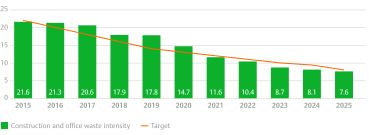
The total percentage of non-recycled waste was 18% in 2025 (41% in 2024). Specific for construction and office waste the percentage was 15.8% in 2025 (22% in 2024). This information also supports the information needs with regard to the EU Taxonomy as reported in chapter 6.6. BAM’s waste diverted from landfill in 2025 was 11% (22% in 2024).
Reporting principles and assumptions waste
The reporting scope of waste includes all waste leaving BAM’s sites and offices. Reported waste is mainly based on waste tickets and data provided by suppliers. Reported waste is either measured, calculated or estimated using methods and input data based on BAM’s experience in comparable works. Excavation waste and demolition waste have a total direct measurement of 99% and construction and office waste of 93%.
Construction and office waste consists of temporary and permanent construction and other materials and packaging brought on to sites which are to be discarded and subsequently leave offices, construction sites and/or BAM sites such as depots or premises. Waste is retrieved and processed by third-party waste processors. BAM relies on these processors to adhere to (local) legislations stating that the waste needs to be disposed of in a responsible way.
Data is retrieved from waste recycling reports from the waste facility, certificate of destruction, paper confidential shredding or waste transfer notes, type of waste permit / licence location sent states recycling facility (when removed off site) or demolition reports. Limited data is available for the category prepared for re-use, hence BAM uses a conservative approach in classification, i.e., if evidence is missing waste will be reported as recycled in stead of prepared for re-use. Waste will only be reported in a single category, to avoid double counting.
BAM also reports on the ‘reuse’ amount. This is not included as waste.
Waste reporting does not include subcontractors in ‘own operations’, with the exception of waste numbers for division United Kingdom and Ireland, as this is recognised legally (this implies specific legal rights and obligations).
Waste
|
(in kilotonnes) |
2019 |
2024 |
2025 |
Composition of waste (examples) |
|
Office waste |
4.9 |
2.6 |
2.5 |
|
|
of which: hazardous waste |
- |
- |
- |
|
|
- prepared for reuse |
- |
- |
- |
|
|
- recycled |
- |
- |
- |
|
|
- incineration |
- |
- |
- |
|
|
- landfill |
- |
- |
- |
|
|
of which: non-hazardous waste |
- |
2.6 |
2.5 |
|
|
- prepared for reuse |
- |
- |
- |
|
|
- recycled |
- |
0.9 |
1.0 |
Paper, cardboard, metal, coffee grounds |
|
- incineration |
- |
1.7 |
1.5 |
Food garbage, plastics, municipal waste |
|
- landfill |
- |
- |
- |
|
|
of which: reuse |
- |
- |
- |
|
|
Construction waste |
122.6 |
49.7 |
51.2 |
|
|
of which: hazardous waste |
- |
0.2 |
0.7 |
|
|
- prepared for reuse |
- |
- |
- |
|
|
- recycled |
- |
0.1 |
0.5 |
Dead batteries, empty spray cans |
|
- incineration |
- |
- |
- |
|
|
- landfill |
- |
0.1 |
0.2 |
|
|
- other disposal operations |
- |
- |
||
|
of which: non-hazardous waste |
- |
49.5 |
50.5 |
|
|
- prepared for reuse |
- |
1.4 |
1.5 |
Glass wool insulation |
|
- recycled |
- |
39.7 |
43.7 |
Concrete surplus, metals packaging skips |
|
- incineration |
- |
6.1 |
4.0 |
|
|
- landfill |
- |
2.2 |
1.3 |
|
|
of which: reuse |
- |
- |
- |
Pallet, fence, construction materials |
|
(in kilotonnes) |
2019 |
2024 |
2025 |
Composition of waste (examples) |
|
Excavation waste |
2,664.9 |
785.5 |
1,112.4 |
|
|
of which: hazardous waste |
- |
44.1 |
16.3 |
|
|
- prepared for reuse |
- |
0.4 |
0.1 |
Contaminated soil |
|
- recycled |
- |
19.4 |
8.5 |
|
|
- incineration |
- |
1.2 |
1.1 |
Contaminated invasive plants |
|
- landfill |
- |
23.1 |
6.6 |
Contaminated soils, bitumen with coal tar |
|
of which: non-hazardous waste |
- |
741.4 |
1,096.1 |
|
|
- prepared for reuse |
- |
153.2 |
69.0 |
Soil; excavation |
|
- recycled |
- |
412.4 |
909.7 |
Concrete foundations and pipework |
|
- incineration |
- |
1.5 |
1.3 |
|
|
- landfill |
- |
174.3 |
116.1 |
Soils sent to landfill for capping |
|
of which: reuse |
- |
- |
||
|
Demolition waste |
526.1 |
101.8 |
94.2 |
|
|
of which: hazardous waste |
- |
3.0 |
16.8 |
|
|
- prepared for reuse |
- |
0.3 |
- |
Impregnated window frame |
|
- recycled |
- |
0.4 |
1.7 |
Bitumen with coal tar, TL lighting |
|
- incineration |
- |
0.1 |
0.1 |
Impregnated timber |
|
- landfill |
- |
0.6 |
15.0 |
Asbestos |
|
- other disposal operations |
1.6 |
- |
||
|
of which: non-hazardous waste |
- |
98.8 |
77.4 |
|
|
- prepared for reuse |
- |
6.0 |
7.0 |
Doors, stored on depot or sold to broker |
|
- recycled |
- |
83.5 |
68.2 |
Window glazing, concrete debris, timber |
|
- incineration |
- |
0.9 |
0.7 |
|
|
- landfill |
- |
8.4 |
1.5 |
Doors, furniture, carpet, flooring materials |
|
of which: reuse |
- |
- |
- |
|
(in kilotonnes) |
2019 |
2024 |
2025 |
Target 2030 |
|
Total construction and office waste |
127.5 |
52.3 |
53.7 |
|
|
Total construction and office waste intensity (in tonnes per € million) |
17.7 |
8.1 |
7.6 |
5.4 |
|
Total excavation and demolition waste |
3,191.0 |
887.3 |
1,206.6 |
|
|
Total waste |
3,318.5 |
939.6 |
1,260.3 |