Biodiversity and ecosystems (ESRS E4)
Biodiversity refers to the variety and variability of life forms on Earth, including the diversity of species, ecosystems, and genetic variations within those species. It encompasses everything from plants and animals to microorganisms, as well as the ecosystems they form, like forests, oceans, and grasslands. Essentially, biodiversity represents the richness of life in all its forms, and it is crucial for maintaining ecological balance, supporting human life.
The construction sector is a major driver in the decline of biodiversity. BAM aims to help reduce the loss of biodiversity, specifically in its own operations and protect ecosystem services, working towards a world where nature and human activities are in balance. BAM’s strategic approach is focused on gaining insights in the biodiversity impacts on its project and propose and deliver biodiversity enhancing measures where possible.
The following material impacts, risks and opportunities are listed below, these are identified through BAM's double materiality assessment process, full details can be found in chapter 6.1.
|
Material impact, risk or opportunity |
||
|
Biodiversity |
||
|
Biodiversity loss through land use change |
(OO) |
Negative impact |
Transition plan for biodiversity (E4-1)
BAM recognises that its operations can affect biodiversity and ecosystems, both directly during the construction process and indirectly through material sourcing. Land use and land conversion during construction and infrastructure projects present significant challenges for plants and species, and the ecosystems they form. At the same time, BAM has opportunities to make a positive contribution. Targeted restoration measures can create new habitats or improve existing ones. In conclusion, dependencies and impacts create both risks and opportunities. To address this, BAM has integrated biodiversity considerations into its corporate strategy and business model.
Biodiversity related strategic targets include offering biodiversity enhancing alternatives in our developments where BAM is involved in the design process of a tender or development. National and globally recognised frameworks lay the foundation for the biodiversity enhancing measures BAM offers in its tenders and developments. Furthermore, our approach aligns with global biodiversity goals, including the Kunming-Montreal Global Biodiversity Framework (KMGBF), setting a strategic and sustainable direction for achieving a nature-positive world by 2050.
The resilience of BAM's strategy includes consideration of biodiversity related impacts and dependencies. In practice, this translates to integrating sustainable practices in our own operations and value chain.
-
By anticipating and mitigating biodiversity risks in our operations and projects, construction-related impacts are minimised and BAM contributes by restoring degraded ecosystems.
-
In our upstream value chain, BAM implements sustainable resourcing through certified materials and utilizing low-carbon or recycled alternatives to traditional materials.
-
Developing employee expertise to enhance the ability to mitigate biodiversity related risks on projects.
BAM has drawn on the 2019 Intergovernmental Science-policy platform on biodiversity and ecosystem services (IPBES) Global Assessment Report to translate the Kunming-Montreal Global Biodiversity Framework goals into actionable measures for BAM. The identified primary drivers are included in the visual main threats to biodiversity.
Main threats to biodiversity
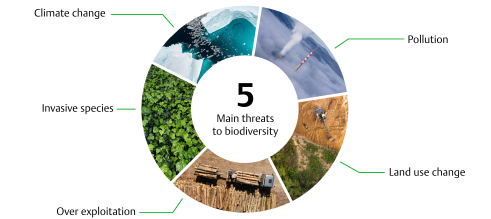
As a result, BAM translated these insights into an actionable biodiversity approach in 2024: BAM Biodiversity+. The assessment was originally developed in the division United Kingdom and Ireland, and has been adapted to the Dutch context. Regulatory and industry best practices lay at the foundation of this approach:
-
ESRS E4 Biodiversity and Ecosystems.
-
The British Standard BS 8583 Biodiversity.
-
The Building Research Establishment Environmental Assessment Method (BREEAM) for Infrastructure.
-
The Chartered Institute of Ecology and Environmental Management (CIEEM) Biodiversity Net Gain: Good practice principles for development.
-
The Expedition Engineering’s Embodied Biodiversity Impacts of Construction Materials research report.
-
GRI 101: Biodiversity 2024.
Material impacts, risks and opportunities and their interaction with strategy and business model (SBM-3)
A detailed overview of sites by identified impacts and dependencies is disclosed in this chapter. BAM's activities can impact biodiversity across all sites it owns or operates. We distinguish between:
-
Direct impact on sites under full operational control (owned land).
-
Indirect impact linked to design and build activities on client-owned construction sites.
BAM considers direct impact on biodiversity when a new construction footprint is causing land use change and loss of habitats as part of the property development activities of BAM. Indirect impacts, more focused on the construction design and build BAM is performing. For instance, shipping and transporting materials can introduce invasive species, which can damage ecosystems over time. In many cases, a single action can cause multiple types of impact; for example, developing a new road to a remote location causes impact through construction and often increases habitat degradation of adjacent areas due to improved access.
To assess material direct impacts, BAM mapped its owned sites against biodiversity-sensitive areas. Proximity thresholds increased compared to the prior year. The applied thresholds are based on the Integrated Biodiversity Assessment Tool (IBAT) methodology. Further details regarding the methodology can be found in reporting principles and applied assumptions. An overview is presented in this paragraph. In total, seven sites are of high relevance, meaning that they are within 500 meters of a key biodiversity area. The remaining sites are more than 500 meters, but less than 10 kilometers from a key biodiversity area.
Number of offices and depots near biodiversity-sensitive areas
|
Country |
Number of locations < 500 m |
Number of locations 500 m - 10 km |
|
Belgium |
1 |
12 |
|
Ireland |
1 |
1 |
|
The Netherlands |
4 |
15 |
|
United Kingdom |
1 |
4 |
BAM also assessed its owned construction sites. Usually BAM only operates on sites owned by the client, but in the Netherlands, we have sites that are owned by BAM's property developer. BAM has assessed how many sites are within 1 kilometer of biodiversity-sensitive areas and if they were actively being developed (i.e. consutruction activities). Out of the identified 47 sites, 14 sites were actively being developed in 2025. These are the sites where BAM potentially has the largest impact on biodiversity. Further details on these sites can be found in Overview of owned sites, depots and offices near biodiversity-sensitive areas, together with the details on the relevant offices and depots.
Owned sites near biodiversity-sensitive areas
|
Total number of |
Number of owned sites with construction activities < 1 km |
Number of owned sites |
|
|
Sites |
47 |
14 |
12 |
In total, BAM has identified 21 material sites with potential negative impacts on biodiversity (7 offices/depots and 14 construction sites that were actively being developed in 2025). On these sites, BAM may contribute to land-use change. The combined area of these 14 sites is approximately 500 hectares, representing the theoretical maximum of hectares subject to biodiversity impact. The actual figure is expected to be significantly lower, as BAM typically develops only part of the land on larger projects.
BAM has not yet performed an individual biodiversity impact assessment for these sites, although offices in the United Kingdom have been assessed. BAM focuses on offering biodiversity enhancing measures to our clients and implement them where possible. Performing individual assessments on the limited number of owned sites provides limited additional value. As no biodiversity impact assessments were conducted at individual site level, BAM cannot provide an exact figure for land-use conversion.
On sites where active development takes place, we promote biodiversity by integrating habitats for a variety of species into our development plans. The goal of the property development part of our business is to leave each area with more flora and fauna species than before development. We select landscape architects based on their biodiversity expertise and work closely with ecologists to monitor the effects of our measures. Various biodiversity measures have been taken, such as the inclusion of bat boxes, swallow boxes, and the creation of mixed hedgerows. Moreover, we have incorporated several hectares of oil flax and elephant grass (Miscanthus) in our projects.
Overview of owned sites, depots and offices near biodiversity-sensitive areas
|
Country |
Location |
Address |
Size (m2) |
Nature area designation |
Identified activities |
|
Belgium |
Chaudfontaine |
Rue Joseph Deflandre 2, 4053 |
28,807 |
Vallé D'Ourthe |
Depot |
|
Ireland |
Cork |
T45 R902, Ireland |
5,000 |
Great Island Channel SAC |
Office |
|
The Netherlands |
Delft |
Harnaschpolder |
26,104 |
Natuur Netwerk Nederland |
Active development |
|
The Netherlands |
Dordrecht |
Wilgenwende |
347,803 |
Natuur Netwerk Nederland |
Active development |
|
The Netherlands |
Gorinchem |
Hoog Dalem |
5,075 |
Natuur Netwerk Nederland |
Active development |
|
The Netherlands |
Haarlemmermeer |
Wickevoort |
535,196 |
Natuur Netwerk Nederland |
Active development |
|
The Netherlands |
Hoef en Haag |
Grex omslag |
480,870 |
Natuur Netwerk Nederland |
Active development |
|
The Netherlands |
Lelystad |
De serpeling 120 |
3,201 |
Natuur Netwerk Nederland |
Office |
|
The Netherlands |
Middelharnis |
Hernesseroord |
63,539 |
Natuur Netwerk Nederland and N2000 |
Active development |
|
The Netherlands |
Moordrecht |
Zuidplaspolder |
1,573,030 |
Natuur Netwerk Nederland |
Active development |
|
The Netherlands |
Purmerend |
Kwadijkerpark |
151,909 |
Natuur Netwerk Nederland and N2000 |
Active development |
|
The Netherlands |
Roermond |
Randweg |
500 |
Natuur Netwerk Nederland |
Office |
|
The Netherlands |
Rosmalen |
Vinkeveld |
350 |
Natuur Netwerk Nederland |
Office |
|
The Netherlands |
Rotterdam (Feyenoord) |
Feyenoord-city |
5,260 |
Natuur Netwerk Nederland |
Active development |
|
The Netherlands |
Rotterdam (Stadionweg) |
Stadionweg 23 |
2,190 |
Natuur Netwerk Nederland |
Office |
|
The Netherlands |
Terneuzen (Zuid zuid) |
Othene zuid-zuid |
341,294 |
Natuur Netwerk Nederland |
Active development |
|
The Netherlands |
Terneuzen (Zuid) |
Othene zuid |
305,105 |
Natuur Netwerk Nederland and N2000 |
Active development |
|
The Netherlands |
Weesp |
Bloemendalerpolder |
844,341 |
Natuur Netwerk Nederland and N2000 |
Active development |
|
The Netherlands |
Zaandam |
Saendelft |
148,599 |
Natuur Netwerk Nederland and N2000 |
Active development |
|
The Netherlands |
Zierikzee |
Noorderpolder |
124,957 |
Natuur Netwerk Nederland |
Active development |
|
United Kingdom |
Allbrook |
SO50 4 LY |
6,500 |
River Itchen SSSI |
Depot |
Compared to 2024, our approach to disclosing owned sites, offices, and depots has been refined. Applying the updated 2025 methodology to the 2024 data we see that the number of owned sites near biodiversity sensitive areas remained stable. In 2025, BAM’s portfolio included 47 owned sites within 1 kilometer of a biodiversity-sensitive area (2024: 47). Comparing further details with 2024, such as the sites with construction activities or the combined area, is impracticable as this information was not captured for 2024. The number of owned offices and depots within 500 meters of a biodiversity-sensitive area also remained unchanged, totaling 7 in each year.
Reporting principles and assumptions biodiversity
The methodology for the assessment of relevant sites near biodiversity-sensitive areas has two main elements:
-
Determining which sites are in scope.
-
Determining relevant thresholds for proximity.
Scope definition
BAM considers only owned sites as sites where we have full control. Sites where we perform construction activities on behalf of clients and leased offices and depots have been excluded from the disclosure. The assessed sites are all sites where we have (partial) ownership, such as offices, depots and land positions.
Applied thresholds
BAM has defined what distance is considered ‘near’ biodiversity-sensitive areas in the context of BAM’s own operations. The relevant distance depends on local aspects, such as type of habitat and presence of species, and can substantially vary case by case. Although standardised buffer zones may not fully capture specific ecological sensitivities or species-specific impact ranges, which could either under- or overestimate the actual zone of influence for some biodiversity impacts, a practical approach was implemented.
In 2025, BAM applied a different approach to determine the thresholds for proximity compared to previous year. In 2024 we considered the following thresholds to identify a material site: 5 kilometer for international designated sites; and 2 kilometer for nationally designated sites. This year, the thresholds are based on the buffer zone guidance provided by the Integrated Biodiversity Assessment Tool (IBAT). IBAT suggests a buffer zone of 10 kilometers for construction related activities, and considers the following thresholds to determine high significance:
-
1 kilometer for construction activities.
-
500 metres for offices and depots.
A geographic information system (GIS) is used to determine distance to the nearest key biodiversity area. BAM is currently not carrying out a fully location-based mitigation strategy, however, details of the assessment are included in this overview. As the owned asset list is currently compiled partly through manual processes, BAM is working to enhance the completeness of this assessment across all business units.
Description of the processes to identify and assess material biodiversity and ecosystem-related impacts, risks and opportunities (IRO-1)
As disclosed in chapter 6.1 (BAM’s Double Materiality Assessment) and in the ESRS E4 SBM-3 analysis above, BAM has screened its business activities in order to identify its actual and potential impact. Based on internal consultations with subject matter experts, and consultations with key parties in BAM’s supply chain, the relevant activities have been identified.
Policies related to biodiversity and ecosystems (E4-2)
BAM's sustainability policy references biodiversity but does not include explicit measures for identifying, assessing, managing, or remediating material biodiversity and ecosystem impacts, risks, or dependencies. The current policy is limited to timber, and does not explicitly address production, sourcing, or consumption of ecosystems or other social consequences of biodiversity-related impacts. The policy prescribes to only procure certified renewable timber, reducing the risk of deforestation and forest degradation in BAM's timber supply chain.
BAM will be subject to the EU Deforestation Regulation (EUDR), which has been delayed to 30 December 2026, specifically for the division Netherlands. The original proposal was simplified: Only businesses that are first to place a relevant product on the EU market will be responsible for submitting due diligence statements, and not the operators and traders that subsequently commercialise it. BAM is only importing timber directly for our timber housing factory, so impact on BAM's procurement processes is expected to be limited.
Actions and resources in relation to biodiversity and ecosystems (E4-3)
Biodiversity requirements are part of the stage gate process to support the roll-out of biodiversity enhancing measures in our tenders. All tenders with design in scope are requested to offer biodiversity enhancing measures to the client.
In 2025 BAM continues to offer Biodiversity+ assessments on projects. The assessment is a framework, bridging regulatory and science-based methodology with BAM's operations. By offering the assessment BAM aims to add value that complements societal and client needs. Priority is on user-friendliness, by distilling complex jargon into understandable and practical principles. We carried out 79 Biodiversity+ assessments (62 in division United Kingdom and Ireland and 17 in division The Netherlands) in 2025. The Biodiversity+ assessments provide useful insights in the nature related risks and opportunities of our projects.
Across BAM's business wider development of the theme is ongoing, the focus is on a learning and development approach. An e-learning, tailored to the role and involvement at different project stages, has been published. The project stages are tenders, design and execution. Furthermore, across the company best practices of biodiversity enhancing measures are shared through a sustainability library.
We do not currently apply biodiversity offsetting. Our initial focus is on gaining insight into our impacts and taking steps to reduce negative effects. Focus is on continuing efforts to improve biodiversity related data management systems and increase insights into biodiversity impacts on projects. Through engagement with all relevant stakeholders, both internally and externally, BAM aims to mitigate negative impacts, while increasing biodiversity action-based value creation on its projects.
Targets related to biodiversity and ecosystems (E4-4)
BAM has included biodiversity in its strategy and has set the target to offer biodiversity enhancing measures in A,B,C tenders with design in scope in 2026. Furthermore, BAM has the ambition to work towards a biodiversity positive impact by 2030. The offering of biodiversity enhancing measures is the first step to address biodiversity risks and opportunities in our projects. To reach the 2030 ambition, more tangible targets covering all aspects of our biodiversity impact will be needed.
BAM has set targets in line with the Kunming-Montreal Global Biodiversity Framework. We believe that by contributing to these targets BAM provides support for the transition towards a nature inclusive and biodiverse construction sector. BAM did not apply ecological thresholds when setting these targets. For our targets on biodiversity balanced and biodiversity positive, BAM anticipated to use the United Kingdom Biodiversity Net Gain (BNG) approach developed by the British Government to use as the metric to report biodiversity impact. However, aggregating BNG impacts across different projects is complex and applying BNG on all projects turned out to be infeasible. Therefore, BAM has dropped its 2026 target on evidenced biodiversity balanced in the division United Kingdom and Ireland.
BAM's Biodiversity+ assessment covers drivers other than BNG, such as pollution and invasive species. BAM is currently rephrasing the 2030 ambition on biodiversity positive impact, expanding the scope to nature impact but making our efforts more specific. Our efforts focus on:
-
Minimising negative impacts in the supply chain.
-
Protecting nature during construction phase.
-
Restoring and enhancing nature through assets we deliver.
In 2026, we plan to finalise new specific nature targets for 2030, where we consider to set specific targets addressing our key impacts at construction sites and our lasting impact when we finalise projects. Our upstream impact is also in scope but concrete targets are not yet expected to be formulated in 2026.
Impact metrics related to biodiversity and ecosystems (E4-5)
BAM has incorporated the offering of biodiversity-enhancing measures into its sustainability baseline. In 2025, we offered measures in 84% of our large tenders with design in scope. 2025 was the first year that BAM was able to provide consolidated figures and marks an important milestone towards ensuring a 100% score on this metric in 2026.