5.2 Remuneration report
Introduction
2025 has been a strong year for BAM during which it demonstrated the effectiveness of its strategy and the disciplined execution required to deliver predictable, profitable and sustainable performance. As the Company progressed through the Transform phase of its 2024–2026 strategy cycle, the Supervisory Board continued to ensure that remuneration target setting and outcomes for the Executive Board remained firmly aligned with BAM’s strategic objectives, sustainability ambitions and the long-term interests of stakeholders.
In 2025, safety has been a top priority. BAM implemented six Life Saving Rules and eight Safety Principles, with highly engaged leadership visible throughout the organisation. The Supervisory Board values this focus on a strong safety culture and considers it to be essential to BAM’s success. BAM also continued to make progress with its sustainability ambitions. The Group further reduced CO₂ emissions, expanded the use of low‑carbon and circular materials, and strengthened its role in developing sustainable housing and infrastructure. These efforts illustrate how sustainability remains central to the Company’s way of working and long‑term value creation.
The above activities took place against the background of BAM’s Executive Board remuneration policy, introduced in 2024. The policy seeks to promote clear alignment between pay and performance, to reinforce the link to BAM’s long‑term ambitions, and to encourage responsible and sustainable leadership, all while ensuring transparency and fairness across the organisation. In 2025, the Supervisory Board applied this policy consistently in assessing performance and determining outcomes.
Incentive outcomes over 2025
On the basis of BAM’s excellent business results, the Supervisory Board determined the outcomes of the incentive plans for the Executive Board. Subsequently, it applied the discretion framework included in the remuneration policy to review these formulaic short-term incentive plan (STIP) and long-term incentive plan (LTIP) outcomes and make sure these were aligned with the guiding principles of the policy. In doing so, the Supervisory Board considered a broad range of qualitative and quantitative factors, such as progress on strategic objectives, risk management, safety incidents and the interests of stakeholders. Based on this holistic assessment, it was concluded that the formulaic outcomes fairly represented the Company’s underlying performance in 2025 and therefore did not require adjustment.
The outcomes for both the STIP and the LTIP reflect the strong operational and financial results delivered during the year, including an improved adjusted EBITDA margin and continued progress on strategic and sustainability objectives. This results in a STIP payout for the Executive Board of 97.5% of fixed remuneration. Furthermore, 132.8% of the conditionally awarded shares under the 2023–2025 LTIP will vest, reflecting strong profitable growth, significant shareholder value creation over the three‑year performance period and excellent performance on the sustainability objectives. Further details on the STIP and LTIP outcomes for 2025 are presented in these tables of this report.
Incentive objectives for 2026
As BAM prepares for the final year of the current 2024–2026 strategy cycle, turning its attention to the Expand phase, the Supervisory Board has set ambitious objectives for both STIP 2026 and LTIP 2026–2028. These objectives continue to focus on sustainable financial performance and other important drivers of BAM’s long‑term success.
Given the Company’s progress in strengthening the safety culture and leadership engagement, the Supervisory Board decided to maintain the enhanced safety‑related objective introduced in 2025, ensuring visible executive involvement in driving continuous improvement on safety across both divisions. Sustainability objectives furthermore remain a core component of both STIP and LTIP, reflecting the importance of long‑term environmental and social impact to BAM’s strategy. Full details of the STIP 2026 and LTIP 2026-2028 targets and performance measures are presented in this graphic of this report.
Conclusion
With strong financial performance, a clear strategic direction and a continued commitment to sustainable and responsible business practices, BAM enters 2026 well positioned for further growth. The Supervisory Board is confident that the remuneration framework, as reviewed and adopted in 2024, remains fit‑for‑purpose and supports the long‑term interests of shareholders, employees, clients and society.
This report provides a detailed overview of the remuneration of the Executive Board and Supervisory Board in 2025 and an outlook for 2026. The full remuneration policy is available on BAM’s website
Bunnik, the Netherlands, 25 February 2026
On behalf of the Supervisory Board,
Denise Koopmans, Chair of the Remuneration Committee

Remuneration of the Executive Board in 2025
The members of the Executive Board received remuneration in the past financial year in line with the remuneration policy adopted by the Annual General Meeting on 10 April 2024.
The remuneration policy for the Executive Board is available on BAM’s website
Total remuneration Executive Board
|
Fixed remuneration |
Short-term incentive |
Long-term incentive 1 |
Other benefits 2 |
Post-employment benefits |
Total remuneration |
|||||||
|
(x €1,000) |
2025 |
2024 |
2025 |
2024 |
2025 |
2024 |
2025 |
2024 |
2025 |
2024 |
2025 |
2024 |
|
R.J.M. Joosten |
892 |
854 |
877 |
706 |
1,231 |
974 |
22 |
22 |
196 |
188 |
3,218 |
2,744 |
|
H. de Pater ³ |
396 |
- |
386 |
- |
334 |
- |
15 |
- |
87 |
- |
1,218 |
- |
|
L.F. den Houter |
103 |
610 |
- |
504 |
178 |
668 |
4 |
22 |
23 |
134 |
308 |
1,938 |
The remuneration of members of the Executive Board was not affected by a change of control at the Company and no loans or options were issued to them. The Supervisory Board did not see any reason during the financial year to use its extraordinary powers to adjust or reclaim variable remuneration that has been awarded previously.
Fixed remuneration
The Supervisory Board reviewed the fixed remuneration in line with the remuneration policy for the Executive Board. Based on macro economic developments, market information and increases of the wider BAM workforce in the Netherlands, the fixed remuneration of Mr Joosten was increased by 3.5% per 1 April 2025 to €899,000 gross per annum. The fixed remuneration of Mr de Pater was set per his appointment at the market level of €611,000 gross per annum.
Incentives
Based on input from the Remuneration Committee, the Supervisory Board evaluated the outcomes of the short-term incentive plan (STIP) over 2025 and the long-term incentive plan (LTIP) over 2023-2025 in relation to the objectives that had been set. The Supervisory Board then reviewed the appropriateness of these formulaic outcomes against the discretion framework defined in the remuneration policy.
As explained in the introduction, it was concluded that the formulaic outcomes were reasonable and fair and discretionary adjustments were not required. Therefore, the payout of the short-term incentive plan has been determined at 97.5% of fixed remuneration and the vesting percentage for the long-term incentive plan has been determined at 132.8%. Further details on the achievement of the performance objectives can be found in these tables of this report. The conditional performance shares that were awarded under the LTIP 2023-2025, will vest on 20 April 2026.
Post-employment benefits and other benefits
Both Mr Joosten and Mr de Pater (per appointment as CFO) received an age-independent gross allowance of 22% of their fixed remuneration as pension contribution, in line with the remuneration policy.
Terms of appointment of the Executive Board members
Members of the Executive Board are appointed for a term of four years, and deliver their services under a management services agreement. Details of their appointment are specified in chapter 4.3. The notice period is three months for both the Company and the Executive Board member, the maximum severance is one year’s fixed remuneration in case of termination by the Company.
Performance on 2025 short-term incentive objectives
|
Objective |
Weighting (%) |
Achievement on performance objectives |
Achievement |
Achievement |
STIP (% of fixed |
|
|
Financial |
Adjusted EBITDA |
45 |

|
BAM delivered a strong performance with an adjusted EBITDA of €400 million. |
150 |
43.9 |
|
Total cash flow |
25 |

|
The total cash flow significantly exceeded excellent level. |
150 |
24.4 |
|
|
Non-financial |
Employee engagement (action taking) (in %) 2 |
10 |

|
Employee engagement has increased and exceeded expectations. |
150 |
9.8 |
|
Safety 3 |
10 |

|
The Executive Committee has taken the lead in driving an improved safety culture. |
150 |
9.8 |
|
|
Scope 1 and 2 CO2 intensity |
10 |

|
The reduction of Scope 1 and 2 CO2 intensity continued and was larger than anticipated. |
150 |
9.8 |
|
|
Overall achievement |
97.5 |
|||||

|
Performance on 2023-2025 long-term incentive objectives
|
Objective |
Weighting (%) |
Achievement on performance objectives |
Achievement |
Achievement |
Vesting |
|
|
Financial |
Relative TSR 1 |
33.3 |
Position 3 |
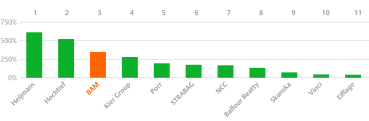
See the next graph for the TSR peer group ranking. BAM’s relative TSR performance ended up in the targeted 3rd position. |
100 |
33.3 |
|
Adjusted EBITDA (in %) 2 |
33.3 |

|
At 5.97%, excellent level was almost achieved upon applying the agreed calculation methodology for LTIP. |
148.5 |
49.5 |
|
|
Sustainability |
CDP Climate Ranking |
11.1 |

|
BAM earned a spot on the prestigious CDP Climate A List, for the seventh consecutive year. |
150 |
16.7 |
|
Scope 1 and 2 CO2 intensity reduction (in %) |
11.1 |

|
The reduction of Scope 1 and 2 CO2 intensity continued and was larger than anticipated. |
150 |
16.7 |
|
|
Construction and office waste intensity reduction (in %) |
11.1 |

|
The reduction of Construction and office waste intensity continued and was significantly larger than anticipated. |
150 |
16.7 |
|
|
Overall achievement |
132.8 |
|||||
|
|
TSR peer group ranking LTIP 2023-2025
Share-based payments
|
Opening balance |
||||||
|
LTIP |
Award date |
Vesting date |
End of lock-up period |
Status of shares |
No. of shares 1 |
|
|
R.J.M. Joosten 2 |
2025-2027 |
09-05-2025 |
09-05-2028 |
09-05-2030 |
- |
- |
|
2024-2026 |
18-04-2024 |
18-04-2027 |
18-04-2029 |
conditional |
218,900 |
|
|
2023-2025 |
20-04-2023 |
20-04-2026 |
20-04-2028 |
conditional |
364,808 |
|
|
2022-2024 |
25-04-2022 |
25-04-2025 |
25-04-2027 |
conditional |
286,165 |
|
|
2021-2023 |
22-04-2021 |
22-04-2024 |
22-04-2026 |
unconditional |
182,004 |
|
|
2020-2022 |
01-09-2020 |
24-04-2023 |
23-04-2025 |
unconditional |
178,872 |
|
|
H. de Pater 3 |
2025-2027 |
09-05-2025 |
09-05-2028 |
09-05-2030 |
- |
- |
|
2024-2026 |
18-04-2024 |
18-04-2027 |
n/a |
conditional |
25,102 |
|
|
2023-2025 |
20-04-2023 |
20-04-2026 |
n/a |
conditional |
70,877 |
|
|
2022-2024 |
25-04-2022 |
25-04-2025 |
n/a |
conditional |
21,843 |
|
|
2021-2023 |
22-04-2021 |
22-04-2024 |
n/a |
unconditional |
22,767 |
|
|
During the year |
Closing balance |
||||||
|
Shares awarded 1 |
Dividend shares 1 |
Shares forfeited |
Adjustment based on actual vesting |
Withhold to cover |
Status of shares |
No. of shares 1 |
|
|
R.J.M. Joosten 2 |
181,521 |
conditional |
181,521 |
||||
|
8,531 |
conditional |
227,431 |
|||||
|
14,217 |
conditional |
379,025 |
|||||
|
(23,847) |
(126,486) |
unconditional |
135,832 |
||||
|
unconditional |
182,004 |
||||||
|
unconditional |
178,872 |
||||||
|
H. de Pater 3 |
111,033 |
conditional |
111,033 |
||||
|
978 |
conditional |
26,080 |
|||||
|
1,138 |
conditional |
72,015 |
|||||
|
(1,820) |
(8,893) |
unconditional |
11,130 |
||||
|
unconditional |
22,767 |
||||||
Share ownership of the Executive Board members
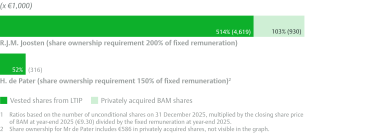
The Company has rules relating to possessing and trading in BAM securities. These rules are published on the Company’s website. The table below shows the value of the shares held by Executive Board members on 31 December 2025.
Share ownership Executive Board members1
Internal pay ratio and five-year analysis
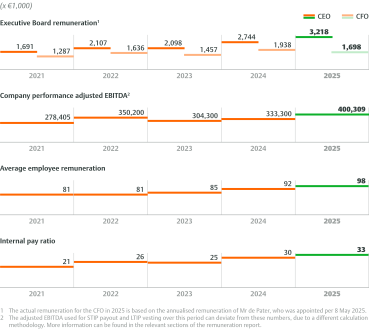
BAM’s internal pay ratio in 2025 was 33 (2024: 30), meaning that its CEO’s pay was 33 times the average pay within the organisation. The increase in the ratio is primarily caused by the increased value of the LTIP and STIP for the CEO, reflecting the increase of the share price and strong performance on the objectives for these plans.
The internal pay ratio is calculated as the total annual CEO remuneration divided by the average employee remuneration (employee benefit expenses excluding restructuring costs and termination benefits divided by the average number of FTE). Both the annual CEO remuneration and the average employee remuneration are derived from the financial statements (IFRS). External employees are not included in the calculation since BAM does not have sufficient information available.
A five-year analysis of Executive Board remuneration versus internal pay ratio, average employee remuneration and company performance can be found in the next table. It contains the performance measure adjusted EBITDA, which is believed to be a crucial reflection of the success of the Company.
Five-year analysis Executive Board remuneration and company performance
Remuneration of the Executive Board in 2026
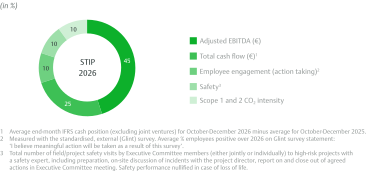
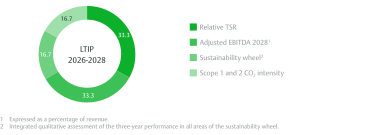
Based on advice from the Remuneration Committee, Audit Committee and Health, Safety and Sustainability Committee, the Supervisory Board determined the performance objectives and their weighting for the 2026 short-term incentive plan and the 2026-2028 long-term incentive plan.
For both the short-term incentive plan and the long-term incentive plan, existing objectives will remain unchanged, albeit that BAM's progress on the ambitions in the sustainability wheel will be determined through an integrated qualitative assessment instead of a predetermined sustainability scorecard. This will allow measurement to become more meaningful and less susceptible to progressive insight over the three-year performance period.
The Relative TSR peer group remains unchanged for the 2026-2028 LTIP award (BAM Group, Balfour Beatty, CFE, Galliford Try Holdings, Heijmans, Hochtief, Kier Group, Morgan Sindall Group, NCC, Peab, Skanska, STRABAG).
Performance objectives and weighting

Remuneration of the Supervisory Board in 2025
The members of the Supervisory Board received remuneration in the past financial year in line with the remuneration policy as adopted by the Annual General Meeting on 10 April 2024. The remuneration policy for the Supervisory Board is available on BAM’s website
The remuneration of the individual members of the Supervisory Board over the last five years can be found in the table below. No options or shares were awarded to members of the Supervisory Board, and no loans were issued to them.
Five-year overview of total Supervisory Board remuneration
|
(x €1,000) |
2025 |
2024 |
2023 |
2022 |
2021 |
|
H.Th.E.M. Rottinghuis, chair |
133 |
131 |
108 |
103 |
102 |
|
B. Elfring, vice-chair |
90 |
84 |
69 |
68 |
62 |
|
J.C. Hanson |
83 |
13 |
- |
- |
- |
|
D. Koopmans |
89 |
87 |
74 |
68 |
65 |
|
M.P. Sheffield |
83 |
82 |
67 |
65 |
59 |
|
N.M. Skorupska |
83 |
88 |
66 |
65 |
42 |
|
G. Boon, former vice-chair |
20 |
85 |
71 |
70 |
67 |
|
H. Valentin, former member |
- |
- |
- |
- |
16 |
|
Total |
581 |
570 |
455 |
439 |
413 |
Share ownership of the Supervisory Board members
The table below shows the shares held by Supervisory Board members on 31 December 2025.
Share ownership Supervisory Board members
|
Type of shares |
Number of shares |
|
|
H.Th.E.M. Rottinghuis, chair |
Privately acquired BAM shares |
100,000 |
|
B. Elfring, vice-chair |
Privately acquired BAM shares |
50,000 |
|
J.C. Hanson |
Privately acquired BAM shares |
2,254 |
|
D. Koopmans |
Privately acquired BAM shares |
15,000 |